

The Retirement Income Problem Nobody Explains Clearly
Most retirement income conversations are framed as a false choice:
- Annuity: Give up control for lifetime income
- Income drawdown: Keep control and hope markets cooperate
There is a third option that combines both—a deferred annuity with a Guaranteed Lifetime Withdrawal Benefit (GLWB). It works like an income drawdown, but with insurance protecting you from running out of money.
This guide explains all three, how they actually work, and when each makes sense.
Definitions At A Glance
Annuities
- What they are: Insurance contracts that can provide guaranteed income for life or a set period.
- How they pay: Either via a lifetime income rider (GLWB) you can turn on when needed, or via annuitization (irreversible). We prefer income riders for flexibility and legacy control.
- Market exposure: Ranges from none (MYGA) to limited upside with protection (fixed indexed annuities).
Investment Drawdown
- What it is: You keep assets invested (e.g., stocks/bonds) and withdraw a planned amount (e.g., 3.5%–5%/yr), adjusting as markets move.
- Your risk: Sequence-of-returns risk (bad early markets), longevity risk (living longer than expected), and behavior risk (panic selling or overspending).
What Is an Annuity and How Does It Work?
An annuity is an insurance contract that converts a lump sum (or a series of contributions) into guaranteed income, typically for life.
How annuities work:
You deposit a lump sum. That money grows tax-deferred (depending on the type). Income is later produced in one of two ways:
- Annuitization (irrevocable conversion to income), or
- Lifetime withdrawals using a GLWB rider
Why annuities exist:
They replace pensions. No investment account can promise lifetime income—annuities can.
You can buy annuities using:
- IRA, 401(k), 403(b) (Qualified funds)
- Roth IRA (tax-free income if rules met)
- Non-qualified brokerage or bank accounts (tax deferral applies)
- Inherited IRAs or inherited non-qualified assets (limited options)
Compare Lifetime Income From An Annuity
What Is a Drawdown Strategy and How Does It Work?
Drawdown involves withdrawing income from an investment portfolio (like IRAs, 401(k)s, brokerage accounts) at a sustainable rate. Your money stays in stocks, bonds, ETFs, or mutual funds. You withdraw a percentage each year. If markets drop early or withdrawals are too high, the damage can be permanent. The most common withdrawal rule is the 4% rule, based on historical market returns, which aims to make your money last for 30 years or more.
The Problem: There is no longevity protection. If the account reaches zero, income stops.
Pros:
- High liquidity and flexibility
- Full control over investments
- Opportunity for growth beyond inflation
- Tailored to your risk tolerance
Cons:
- No income guarantees
- Subject to market volatility and sequence-of-returns risk
- Requires regular rebalancing and oversight
- Emotional decision-making during market downturns
Who Needs It:
- Investors with large portfolios and risk tolerance
- People want full control of their investments
- Those who are comfortable adjusting spending based on market conditions
Who Doesn’t Need It:
- Retirees who want a guaranteed income
- Those who are uncomfortable managing investments or hiring an advisor
- Anyone who fears running out of money due to market declines
The Combination Approach: Drawdown Using GLWB
A GLWB turns income drawdown into an insured strategy.
You still:
- Withdraw income like a drawdown
- Maintain an account value
- Keep beneficiary protection
- Allow the annuity to continue growing
But now:
- The insurance company guarantees income for life
- Running out of money is no longer your problem
Plain English:
A GLWB is insurance for income drawdown.
Why GLWBs are NOT annuitization
This is where most confusion happens.
Annuitization (SPIAs and DIAs)
- A lump sum is permanently surrendered
- No account value remains
- No growth after income starts
- Income is irrevocable
- Less flexibility for beneficiaries
Once income starts, the money is gone.
Deferred annuity with a GLWB
- You keep ownership of the account
- The account continues to grow, even after income starts
- You can stop or delay withdrawals
- Remaining value passes to beneficiaries
- Income is contractually guaranteed for life
Critical distinction:
Deferred annuities with GLWBs do not stop growing.
SPIAs and DIAs do.

Annuity vs income drawdown vs GLWB (real-world examples)
Example 1: Income drawdown
- Savings: $500,000
- Withdrawal: $25,000/year
- Market declines early in retirement
- Outcome: Portfolio drains faster than planned
Income is never guaranteed. Longevity and market timing control the outcome.
Example 2: Traditional annuity (annuitization)
- Deposit: $500,000
- Income starts immediately
- No account value remains
- No growth after start
Income lasts for life—but flexibility and legacy are sacrificed.
Example 3: Deferred annuity with a GLWB
- Deposit: $500,000
- Account grows inside the annuity
- Lifetime withdrawals are activated
- Account value hits zero at age 90
- Income continues for life anyway
Same drawdown concept—with insurance absorbing the failure risk.
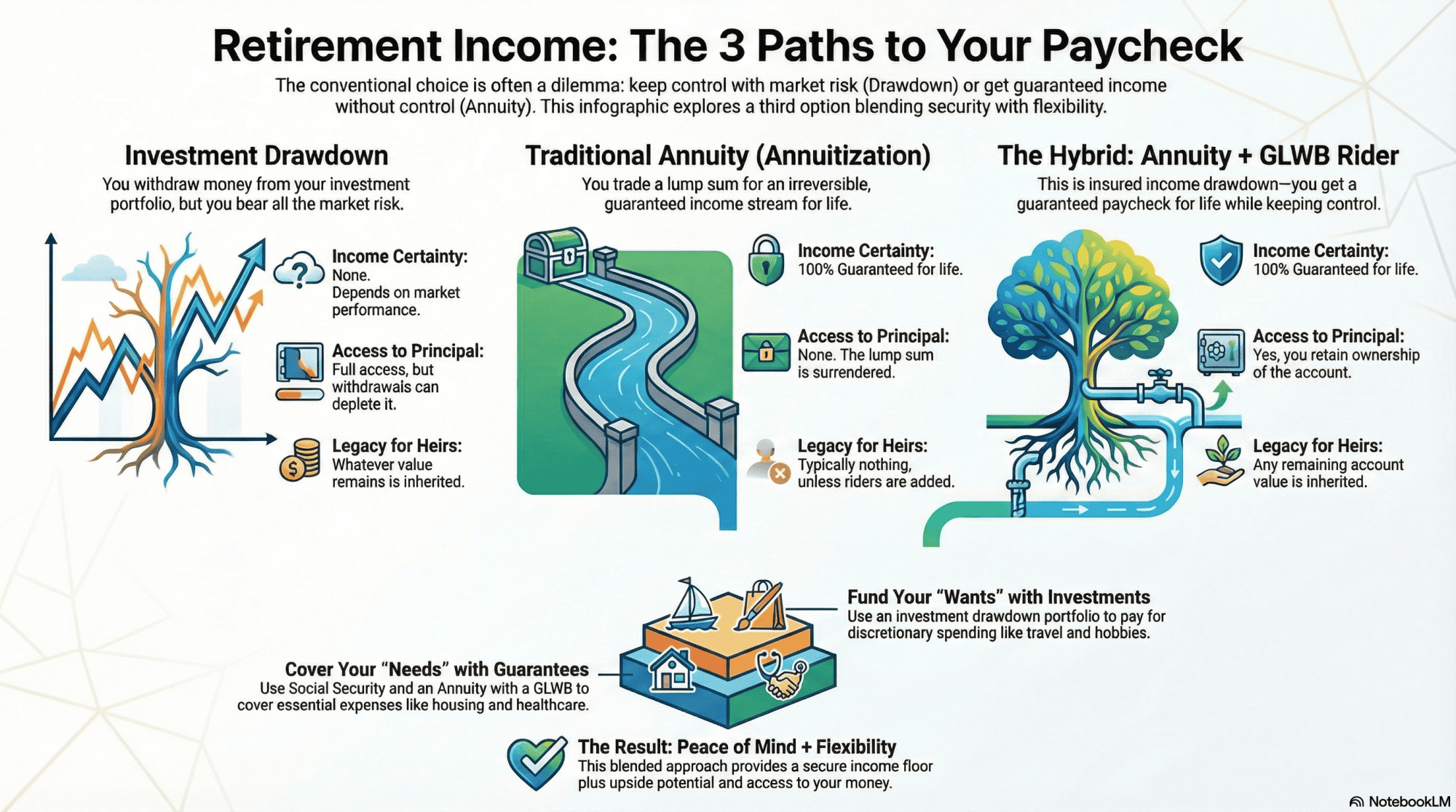
Side-By-Side: What Matters Most
- Income certainty
- Annuities: Can guarantee income for life; riders preserve account control.
- Drawdown: No guarantee; depends on portfolio returns and your withdrawal discipline.
- Flexibility & access to principal
- Annuities: Free withdrawals typically up to 10% per year during the surrender period; income riders let you delay/turn income on or off. Annuitization is the least flexible.
- Drawdown: Full liquidity and control, but no guarantee.
- Market risk
- Annuities: MYGAs remove market risk; FIAs cap or limit downside while offering partial upside.
- Drawdown: Fully exposed to market swings; requires risk management.
- Legacy
- Annuities: With riders (not annuitization), the remaining account value passes to beneficiaries.
- Drawdown: Whatever remains is inherited; sequence risk can reduce what’s left.
- Fees & costs
- Annuities: Income riders may add a fee; MYGAs/FIAs without riders often have low/embedded costs.
- Drawdown: Fund/ETF fees are low, but poor sequence timing can be “costly” in outcomes.
- Taxes
- Annuities: Tax-deferred growth; distributions taxed as ordinary income when withdrawn; can coordinate with RMDs and use QLACs inside qualified plans to delay RMDs (subject to current limits).
- Drawdown: Tax efficiency varies by account type (Roth, traditional, taxable). You control when and where to withdraw, and how much.
When Each Approach Usually Wins
- Choose annuity-heavy if you want a paycheck you can’t outlive, hate market volatility, or have a spouse who needs a predictable survivor income.
- Choose drawdown-heavy if you have ample assets, can cut spending when markets are rough, and value full control/liquidity.
- Blend them if you want the best of both: a calm baseline plus market-driven upside.
How Smart Retirement Plans Use Both
The most effective plans are layered:
- GLWB annuity → Covers essential expenses
- Income drawdown portfolio → Covers discretionary spending
- Social Security → Additional guaranteed base
- Life insurance → Protects spouse and legacy
- Long-term care insurance → Prevents income collapse from care costs
Once income is secured, remaining assets can be used however you want—investing, gifting, or lifestyle spending.
Closing: Get A Personalized Plan That Balances Guarantees, Flexibility, And Taxes
The right mix of annuities and drawdown depends on your essential expenses, risk tolerance, health, tax bracket, and your spouse’s or heirs’ goals. We’ll help you compare top carriers and run side-by-side retirement income scenarios so you see exactly how much guaranteed income you can lock in, how to keep access to your money, and how to pay less in taxes over time. Call 770-755-1565 or contact us to compare quotes and build your retirement income plan today.
Book A Free Consultation
Get help from a licensed financial professional. This service is free of charge.
Let Us Answer Your Questions
Not quite ready for a meeting, but you have a question that needs answering? We’re happy to help. Leave an inquiry below, and one of our staff will respond via email.