

How Will I Be Paid From My Pension?
A pension payout provides retirees with a steady income, often for life, based on factors like years of service, salary, and age at retirement. Pension companies commonly use an annuity to distribute the payments through annuitization, which converts the pension balance into regular payments for life. Common payout options include:
- Life Only Payments: Monthly payments for life but stop upon death.
- Joint and survivor annuity: Continues paying to a spouse after your death.
- Lump sum: A one-time payment of the entire pension value.
- Period-Certain Annuity Option: Guarantees payments for a fixed number of years
1. Lifetime Monthly Payments (Life-Only Pension)
Key stat: Pays out for as long as you live, no matter how long that is.
This is the most common default option. You receive fixed monthly payments for the rest of your life. Once you die, the payments stop—no matter how much you paid in or how long you collected.
✔ Highest monthly income
✔ Guaranteed for life
✘ No payments to spouse or heirs
✘ No lump sum if you die early
Who Needs It:
- Retirees with no dependents
- People who want the highest monthly income
Who Doesn’t:
- Those with a spouse who needs income after they die
- People who want to leave money to their heirs
Helpful Add-on:
A life insurance policy can replace this income for your spouse or family if you pass away early.
2. Joint and Survivor Payout
Key stat: Continues paying income to your spouse after you die—usually at 50%, 75%, or 100%.
This option pays you a lower monthly amount than the life-only option but continues for your spouse’s life if they outlive you. You choose the percentage your spouse receives after you die.
✔ Protects your spouse
✔ Provides income continuity
✘ Lower monthly income than life-only
✘ No payout to children after both spouses die
Who Needs It:
- Married retirees with a dependent spouse
- Families relying on two incomes
Who Doesn’t:
- Single retirees
- Married couples with other sources of spousal support
Also Consider:
Buying life insurance with the higher income from the life-only option can sometimes result in more total money and a larger death benefit.
3. Lump-Sum Pension Payout
Key stat: You take the full value of your pension as a one-time payment.
Instead of monthly payments, you get a lump sum that you can roll into an IRA or manage yourself. This offers flexibility—but puts the responsibility on you to manage the money wisely.
✔ Complete control of funds
✔ Potential for investment growth
✔ Can leave money to heirs
✘ Risk of poor investment returns
✘ No guaranteed income unless you buy an annuity
Who Needs It:
- Savvy investors
- People with shorter life expectancy
- Those wanting to pass wealth to heirs
Who Doesn’t:
- Those uncomfortable managing investments
- People needing a stable, guaranteed income
Helpful Add-on:
Rolling the lump sum into a Fixed Index Annuity with a Guaranteed Lifetime Withdrawal Benefit (GLWB) offers income for life, plus market protection and beneficiary payouts. It’s often the best way to convert a lump sum into guaranteed lifetime income—especially if you’re worried about inflation or market volatility.
4. Period-Certain Annuity Option
Key stat: Guarantees payments for a fixed number of years (e.g., 10, 15, 20), even if you die early.
This option pays income for life but adds a minimum guaranteed period. If you die during that period, your beneficiary receives the remaining payments.
✔ Combines lifetime income with a safety net
✔ Pays heirs if you die early
✘ Lower payments than life-only
✘ No payout after the period ends if you both die
Who Needs It:
- Those worried about dying early
- Retirees with younger dependents
Who Doesn’t:
- People with other sources of legacy income
- Retirees who prioritize maximum monthly payouts
How Pension Annuitization Works—and Why It’s Usually a Bad Deal
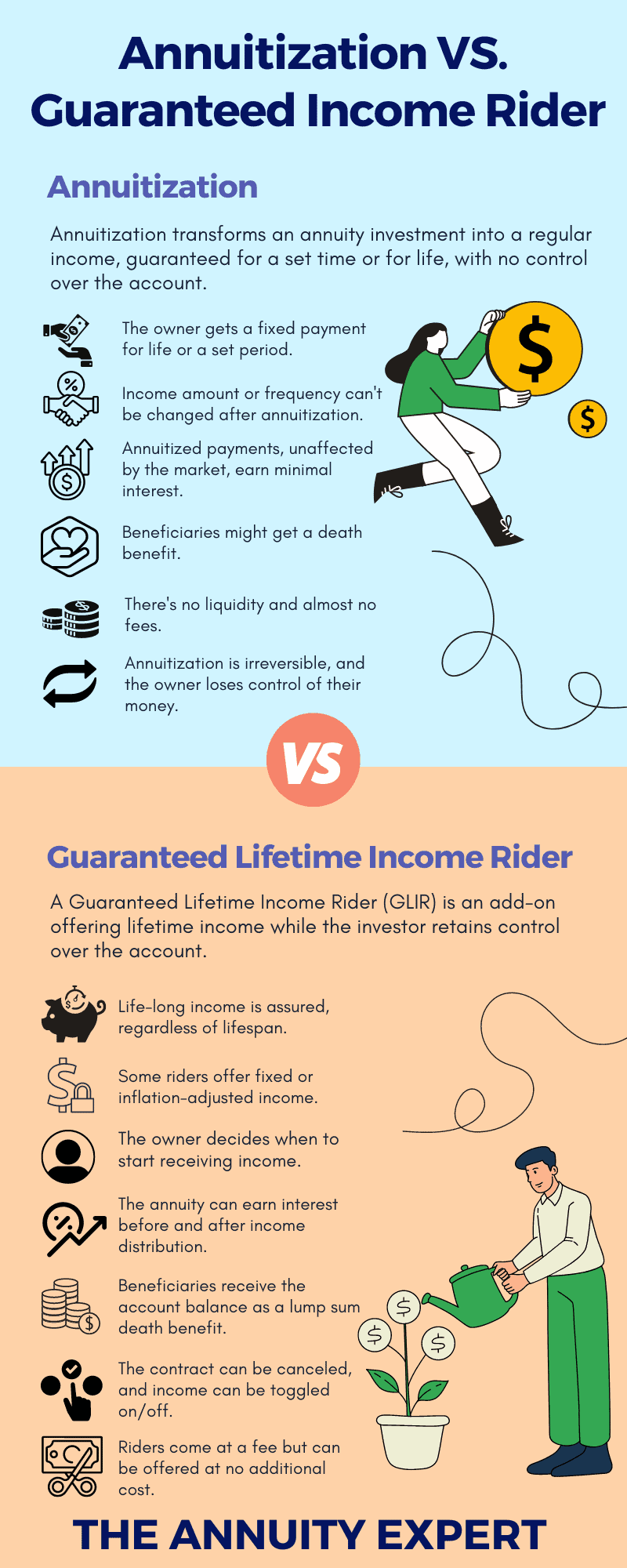
Key stat: Annuitization permanently transfers your lump sum to an insurance company in exchange for fixed monthly payments.
Pension annuitization is when you give up access to your pension balance in exchange for a promise of income for life. Once you annuitize, the contract is locked in: you cannot change the terms, access the principal, or pass on the remaining value to heirs unless you’ve paid for specific rider options.
✘ Irrevocable decision—no access to your funds
✘ No step-up in value or inflation protection
✘ Typically no death benefit unless structured into the payout
✘ Misses out on modern innovations in retirement income
Rolling a Lump Sum into an IRA Annuity with a GLWB
Why the GLWB Is Superior:
A Fixed Index Annuity with a Guaranteed Lifetime Withdrawal Benefit (GLWB) doesn’t require you to annuitize. You maintain control of the account, enjoy market-linked growth with downside protection, and can withdraw income for life—even after the account is depleted. And any unused balance can go to your beneficiaries.
✔ Contractually guaranteed lifetime income
✔ Market growth potential with no downside risk
✔ Remaining balance goes to your heirs
✔ Reversible: GLWBs are almost always revocable
Who Needs GLWB Instead of Annuitization:
- Retirees who want more control
- Those worried about outliving their money
- Individuals seeking inflation-adjusted income streams
Compare Your Income Using Our Annuity Calculator
To see how much income you could receive by rolling your pension lump sum into an annuity with a GLWB, use our Annuity Calculator to compare potential income amounts. This tool will help you evaluate whether an annuity rollover is a better option for you than your current pension payout.
Final Thought:
Choosing your pension payout option is one of the biggest retirement decisions you’ll ever make. It affects your income, your spouse’s security, and your ability to leave money behind. Don’t guess.
Book a call with The Annuity Expert to compare all your payout options—including life insurance and annuity strategies—and get free, no-obligation quotes to protect your future.
Book A Free Consultation
Get help from a licensed financial professional. This service is free of charge.
Let Us Answer Your Questions
Not quite ready for a meeting, but you have a question that needs answering? We’re happy to help. Leave an inquiry below, and one of our staff will respond via email.