

What a quarter-million dollars realistically pays in retirement—and why the number is never the same for everyone.
For many retirees, converting a lump sum into a dependable monthly check feels like building a personal pension. The real issue isn’t whether an annuity pays income—it’s how much income you can realistically expect and what trade-offs come with it.
The quick answer:
For most people between ages 65 and 70, a $250,000 annuity typically pays between $1,375 and $1,875 per month based on 2026 benchmarks, assuming a plain-vanilla lifetime income structure.
Why it varies:
$250,000 isn’t a paycheck—it’s capital. The insurance company prices income using your age, life expectancy, and how much risk protection you demand. Add protection for a spouse, heirs, or inflation, and the starting check shrinks. Remove those protections, and income increases.
An annuity guarantees this check for life. But if you try to replicate this income by just withdrawing cash from the bank, you run a high risk of depleting your account too early. See the math: How long will $250,000 actually last?
Annuity Income Heat Map
The income heat map below shows how lifetime payouts can differ depending on the age when income begins and whether payments are deferred. Use our life annuity calculator to compare additional estimates. Fill out the contact form below to request an income heat map specific to your age, state, and income needs.

Payout Estimates by Age and Gender (2026 Benchmarks)
The age factor:
Older buyers receive larger monthly payments—not as a perk, but because payments are expected to last fewer years. Younger buyers receive smaller checks because the insurer expects a longer payout period.
Sample estimates – Immediate Life-Only Annuity ($250,000 premium):
- Age 60: ~$1,350/month (Male) | ~$1,275/month (Female)
- Age 65: ~$1,500/month (Male) | ~$1,400/month (Female)
- Age 70: ~$1,700/month (Male) | ~$1,575/month (Female)
- Age 75: ~$1,950/month (Male) | ~$1,725/month (Female)
These assume immediate income, single life, no inflation adjustment, and no refund or survivor features. Change any one variable and the payout changes.
Level Income Payouts for a $250,000 Annuity
A level income payout pays the same dollar amount every month for life or a specified period. Once income starts, it never increases.
Why people choose it:
- Highest possible starting income
- Ideal for covering fixed costs like housing, utilities, and insurance
The downside:
- Inflation steadily reduces purchasing power
- What feels adequate today may feel tight decades later.
Illustrative examples for $250,000:
| Age at Purchase | Start Now | Start in 5 Years | Start in 10 Years | Start in 20 Years |
|---|---|---|---|---|
| 45 | ~$1,140 | ~$2,130 | ~$3,220 | ~$6,395 |
| 55 | ~$1,575 | ~$2,545 | ~$3,975 | ~$7,610 |
| 65 | ~$1,900 | ~$2,910 | ~$4,550 | ~$8,090 |
| 70 | ~$2,085 | ~$3,180 | ~$5,105 | ~$6,905 |
Deferring income can meaningfully increase future payments but requires patience and other income sources in the meantime.
$250,000 Annuity Increasing Income Payouts
An increasing income payout starts lower and grows over time based on a contractually defined increase.
Who does this work for:
- Retirees with other income early on
- Those who are more concerned about purchasing power later in life
The trade-off:
- Smaller checks upfront
- Higher income later
For $250,000, the starting income is usually 10–25% lower than a comparable level payout.
| Age at Purchase | Now | Start in 5 Years | Start in 10 Years | Start in 20 Years |
|---|---|---|---|---|
| 45 | $786.75 | $1,292.75 | $2,012.50 | $3,366.75 |
| 55 | $1,145.75 | $1,604.25 | $2,459.25 | $4,133.25 |
| 65 | $1,458.25 | $2,117.75 | $3,156.00 | $5,533.25 |
| 70 | $1,498.00 | $2,253.25 | $3,311.25 | $4,479.00 |
Joint Life Payouts for a $250k Annuity
A joint life payout provides income as long as either spouse is alive.
Why income drops:
The insurer expects a longer payout duration.
Why couples still choose it:
- Protects the surviving spouse
- Prevents income loss at the first death
This option prioritizes survivor security, not maximizing income.
| Age | Age 60 | Age 65 | Age 70 |
|---|---|---|---|
| Age 60(Spouse 2) | $1,363.50 | $1,363.50 | $1,363.50 |
Advanced Payouts on a $250,000 Annuity
An advanced payout provides higher income early, followed by a permanent reduction later.
Why people use it:
- To bridge income gaps before Social Security or pensions
- To front-load income during early retirement years
The reality:
Once the reduction occurs, the lower payment lasts for life. This strategy only works when future income sources are reliable and planned.
| Ages | Years 1-10 | Years 11+ |
|---|---|---|
| Age 60 | $1,687.50 | $1,012.50 |
| Age 65 | $1,875.00 | $1,250.00 |
The tables above are estimates.
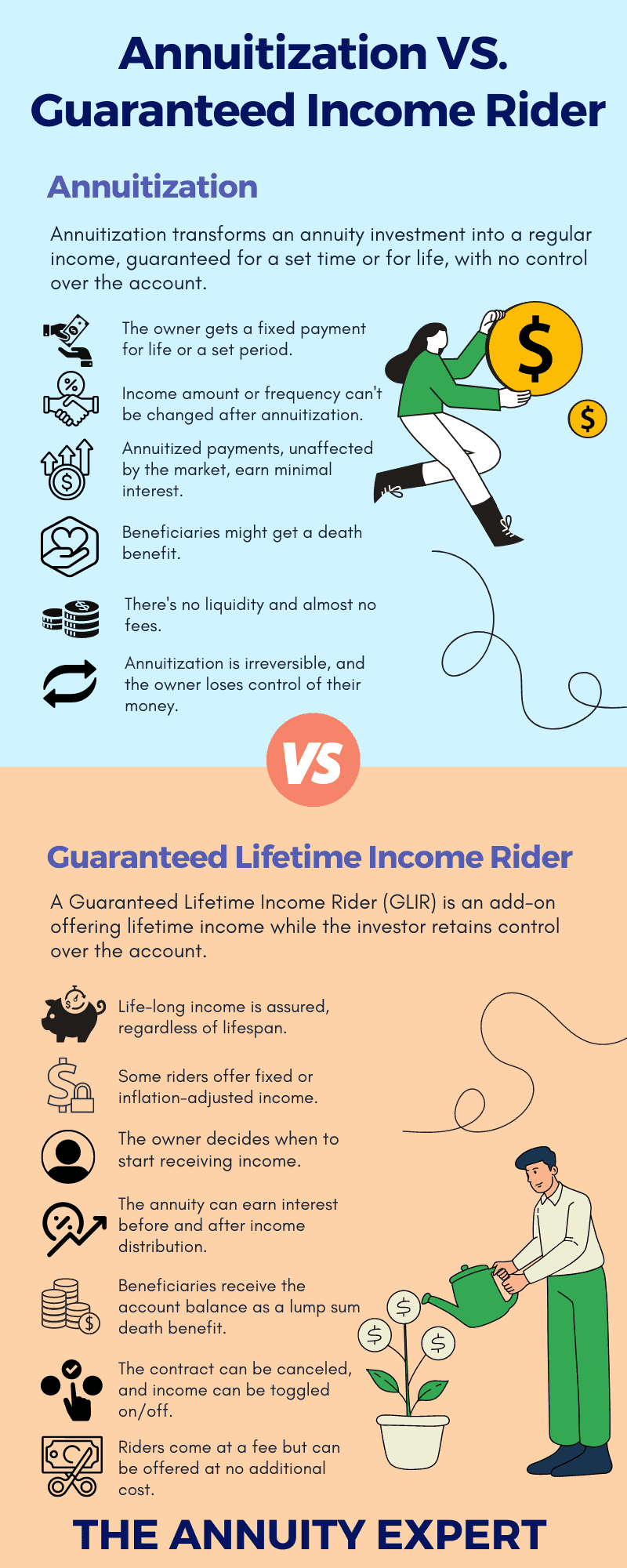
The “Old Way” vs. the “New Way” to Get Annuity Income
The Old Way: Annuitization (SPIA)
You hand over your $250,000 to the insurance company and receive a lifetime paycheck.
What that really means:
- No access to the principal
- Limited or no inheritance
- Irreversible decision
If you die early, payments usually stop unless expensive add-ons were purchased—often leaving nothing behind for heirs.
The New Way: Income Riders (GLWBs)
A Guaranteed Lifetime Withdrawal Benefit (GLWB) provides lifetime income without giving up ownership of the money.
Key difference:
- You keep control of the $250,000
- Income is contractually guaranteed for life.
- Any remaining account value goes to beneficiaries.
You receive income and preserve flexibility and legacy.
Just looking for a safe place for cash? Compare $100,000 Annuity Options
Why This Matters
Income no longer requires giving up the asset.
With modern annuities, many retirees can:
- Create a personal pension
- Maintain control and liquidity.
- Leave money to heirs.
Most people are never shown this option.
Key Factors Influencing a $250,000 Annuity Payout
- Interest rates:
Higher long-term yields allow insurers to support higher income. Conditions in 2026 remain more favorable than in recent ultra-low-rate years. - Immediate vs. deferred income:
Starting later often increases monthly income but delays certainty. - Inflation protection:
Adding cost-of-living adjustments significantly reduces starting income, with benefits showing up much later.
Tax Implications: What You Actually Keep
Qualified money (IRA or 401(k)):
- 100% of each payment is taxed as ordinary income
- Payments satisfy Required Minimum Distributions (RMDs)
Non-qualified money (cash or brokerage):
- Annuitization: Uses the Exclusion Ratio, splitting payments between taxable interest and non-taxable principal
- GLWBs: Taxed under LIFO, meaning gains are taxed first until exhausted
See What Your $250,000 Can Really Pay.
A $250,000 annuity can provide meaningful lifetime income, but outcomes vary widely depending on structure. The difference between annuitization and modern income riders can determine how much you receive, how much flexibility you keep, and whether your family inherits anything.
At The Annuity Expert, we compare real contracts from multiple A-rated insurance companies and show income options side by side—no pressure, no obligation.
Contact The Annuity Expert for free quotes and see exactly how much lifetime income your $250,000 can generate—without giving up control or disinheriting your family.
Book A Free Consultation
Get help from a licensed financial professional. This service is free of charge.
Let Us Answer Your Questions
Not quite ready for a meeting, but you have a question that needs answering? We’re happy to help. Leave an inquiry below, and one of our staff will respond via email.