

What one million dollars realistically pays in retirement—and why the number is never the same for everyone.
For many retirees, the idea of turning a lump sum into a steady paycheck sounds like a personal pension. But the real question isn’t whether an annuity pays income—it’s how much income you can reasonably expect and what trade-offs come with it.
The quick answer: For most people between ages 65 and 70, a $1,000,000 annuity typically pays between $6,500 and $7,100 per month based on current 2026 benchmarks, assuming a plain-vanilla lifetime income structure.
Why it varies: One million dollars is not a fixed salary. It’s a pool of capital, and the insurance company calculates your monthly payment using your age, life expectancy, and how much risk you’re willing to offload. The more protection you demand—for a spouse, heirs, or inflation—the smaller the initial check.
Jumbo quotes: Most online calculators use “Street Level” rates designed for smaller accounts ($100k). When you invest $1 million or more, many carriers unlock “High-Band” rates. These can add 0.15% to 0.50% to your annual yield or withdrawal percentage.
On a $1,000,000 portfolio, that small difference can equal an extra $50,000 – $100,000 in lifetime income
As you are estimating monthly income from a $1,000,000 annuity, annuity strategies for affluent households can add tax deferral, income, or legacy leverage, but larger allocations make carrier diversification and liquidity limits more important.
Income Annuity Heat Map
The income heat map below illustrates potential lifetime income at several ages and payment-start dates for a larger annuity premium. Use our lifetime annuity payout calculator to examine other scenarios. Fill out the contact form below to receive your own income heat map based on your age, state, and income needs.

Payout Estimates by Age and Gender (2026 Benchmarks)
The age factor: The older you are when income starts, the higher the monthly payment. This isn’t a bonus—it’s math. Shorter life expectancy means fewer projected payments, so each payment is larger. Younger buyers get smaller checks because the insurer expects to pay longer.
Sample estimates – Immediate Life-Only Annuity ($1,000,000 premium):
- Age 60: ~$5,900/month (Male) | ~$5,800/month (Female)
- Age 65: ~$6,600/month (Male) | ~$6,300/month (Female)
- Age 70: ~$7,100/month (Male) | ~$6,800/month (Female)
- Age 75: ~$8,400/month (Male) | ~$7,800/month (Female)
These figures assume income starts immediately, no survivor benefits, no inflation adjustments, and no refund features. Change any of those variables, and the check changes with it.
The tables below show estimated payouts for 2026. However, rates change weekly based on your specific age and state.
$1 Million Level Income Payouts
A level income payout pays the same dollar amount every month for as long as the income is guaranteed to last—whether that’s for life or a specified period. Once payments begin, the amount never changes. This option produces the highest starting monthly income, making it attractive for retirees who want maximum cash flow immediately and plan to cover fixed expenses like housing, insurance, and basic living costs. The downside is simple and brutal: inflation slowly eats away at purchasing power because your payment never increases.
| Age at Purchase | Now | Start in 5 Years | Start in 10 Years | Start in 20 Years |
|---|---|---|---|---|
| 45 | $5,025 | $7,153 | $10,917 | $21,125 |
| 55 | $5,500 | $8,556 | $13,457 | $26,010 |
| 65 | $6,533 | $9,990 | $15,436 | $28,320 |
| 70 | $7,135 | $10,719 | $17,021 | $29,200 |
$1 Million Increasing Income Payouts
An increasing income payout starts with a lower monthly payment but grows over time based on a fixed increase (such as a flat percentage each year) or a contractually defined adjustment. The purpose is to help income keep pace with rising costs later in retirement. This trade-off is clear: you sacrifice income upfront in exchange for higher payments down the road. This option is better suited for retirees who have other income sources early on and are more concerned about maintaining buying power in their late 70s, 80s, and beyond.
| Age at Purchase | Now | Start in 5 Years | Start in 10 Years | Start in 20 Years |
|---|---|---|---|---|
| 45 | $3,147 | $5,171 | $8,050 | $13,467 |
| 55 | $4,583 | $6,417 | $9,837 | $16,533 |
| 65 | $5,833 | $8,471 | $12,624 | $22,133 |
| 70 | $5,992 | $9,013 | $13,245 | $17,916 |
$1 Million Joint Life Payouts
A joint life payout is designed to cover two people, usually spouses. Payments continue as long as either person is alive, not just the first one to pass away. Because the insurance company expects to pay income for a longer period, the starting monthly payment is lower compared to a single-life payout. This option is about survivor protection, not optimization. It’s commonly used when one spouse relies heavily on the other’s income, and losing that paycheck would create a financial gap after the first death.
This table displays the starting income immediately. Payment amounts are based on the youngest spouse’s age.
| Age | Age 60 | Age 65 | Age 70 |
|---|---|---|---|
| Age 60(Spouse 2) | $5,454 | $5,454 | $5,454 |
$1 Million Advanced Payouts
An advanced payout provides higher income in the early years, followed by a permanent reduction later on. This structure is intentional and contractually defined at purchase. It’s designed for retirees who need more income now—often between ages 60 and 75—to bridge gaps until Social Security, pensions, or required minimum distributions begin. The trade-off is unavoidable: once the reduction kicks in, the lower payment continues for life. This option works best when future income sources are reliable and clearly planned.
| Ages | Years 1-10 | Years 11+ |
|---|---|---|
| Age 60 | $6,750 | $4,050 |
| Age 65 | $7,500 | $5,000 |
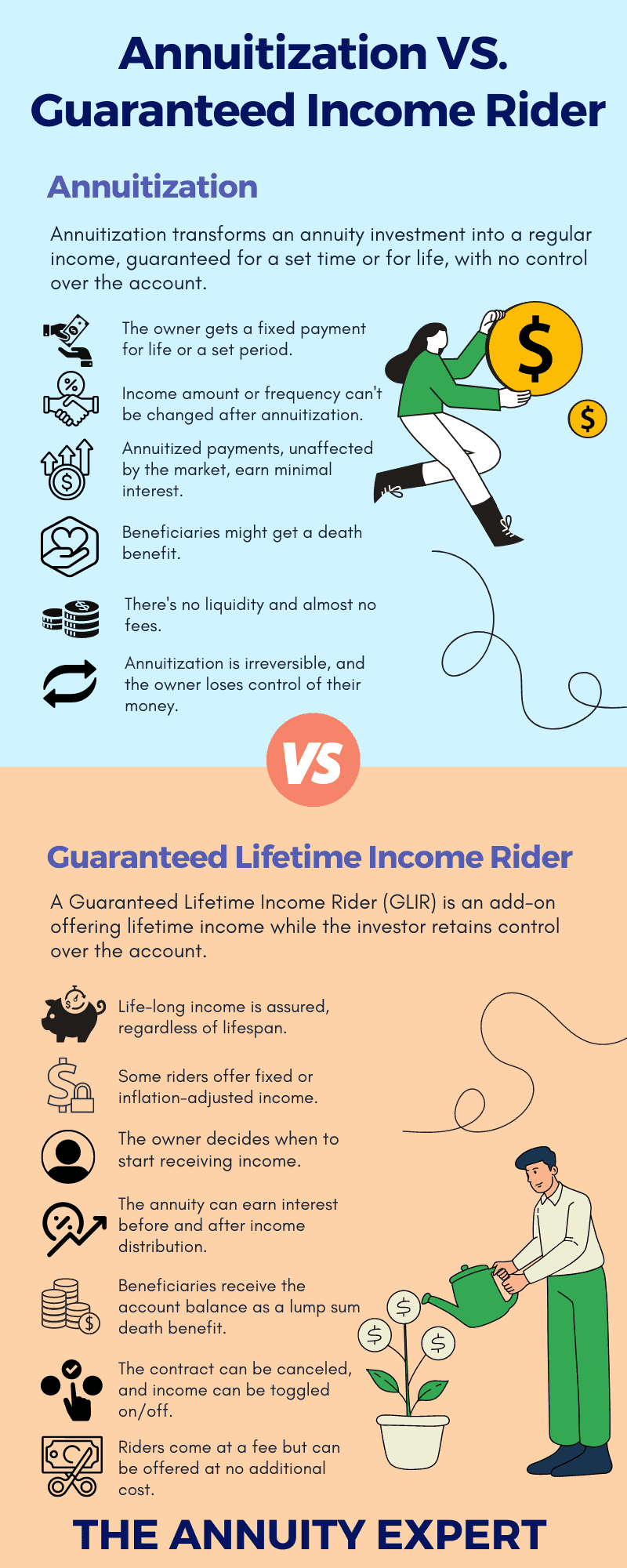
The “Old Way” vs. the “New Way” Annuity Income
Most people still believe there’s only one way to get a guaranteed income from an annuity: hand over the money and hope you live long enough. That belief is outdated—and costly.
The Old Way: Annuitization (SPIA)
The traditional approach is annuitization, most commonly through a Single Premium Immediate Annuity (SPIA). You give the insurance company your $1,000,000, and in exchange, they promise a monthly paycheck for life. Once you annuitize, the money is no longer yours. You’ve converted cash into an income stream.
If you die early, the payments usually stop—unless you added riders like a period-certain or refund feature, which reduce income. In plain terms, this method often disinherits your kids. There’s no account value left to pass on, no flexibility, and no reversing the decision. You traded control for income.
This works only if you’re comfortable with:
- Zero liquidity
- No access to the principal
- Limited or no legacy
- An irreversible decision
The New Way: Income Riders (GLWB)
The modern approach uses a Guaranteed Lifetime Withdrawal Benefit (GLWB) attached to a deferred annuity. Instead of handing over your $1,000,000, you keep it in an annuity account that still belongs to you. The insurance company guarantees a lifetime income without requiring annuitization.
Here’s the key difference:
You receive income for life, and any remaining account value goes to your beneficiaries when you pass away.
The income is contractually guaranteed based on a protected income value, not the fluctuating account balance. If markets perform poorly, your income doesn’t drop. If markets perform well, your account value may grow, increasing what your heirs receive—even while income continues.
This approach allows you to:
- Get lifetime income
- Retain control of the money.
- Maintain beneficiary inheritance
- Avoid irrevocable decisions
Why This Matters
Annuitization made sense decades ago when choices were limited. Today, most retirees don’t need to choose between income and inheritance. With the newer structure, you can build a personal pension without giving up the asset.
That’s the fundamental shift:
Income no longer requires surrendering ownership.
For families who care about flexibility, control, and leaving something behind, the “new way” has quietly replaced the old one—even though many retirees are never told it exists.
Key Factors Influencing Your $1M Payout
- Interest rates: Annuity pricing is tied closely to long-term bond yields, particularly Treasuries and high-quality corporate bonds. When yields are higher, insurers can support higher payouts. As of 2026, rates are still relatively favorable compared to the ultra-low-rate environment retirees faced just a few years ago.
- Immediate vs. deferred income: Starting payments today maximizes certainty but not income. Deferring income for 5 to 10 years allows the annuity value or income base to grow before payouts begin, often resulting in a larger future monthly check. This strategy is common for people still working or bridging to Social Security.
- Inflation protection: Adding a cost-of-living adjustment—such as a 2% or 3% annual increase—significantly reduces the starting income. The benefit shows up years later, but many retirees underestimate how much initial income they give up to hedge against inflation.
Don’t want to commit the full million? Many clients use a $500,000 Annuity Strategy to cover basics while investing the rest.
Tax Implications: What You Actually Keep
- Qualified money (IRA or 401(k)): If the annuity is funded with pre-tax retirement dollars, 100% of each monthly payment is taxed as ordinary income. There’s no capital gains treatment, and the tax bill depends entirely on your marginal tax bracket in retirement. Qualified annuity payments count towards Required Minimum Distributions (RMDs)
- Non-qualified money (cash or brokerage): Only the interest portion of each payment is taxable. The Exclusion Ratio for annuitization. LIFO for GLWBs.
Take the Next Step: See What Your $1,000,000 Can Really Pay
A $1,000,000 annuity can produce meaningful lifetime income—but only if it’s structured correctly. Payouts vary widely based on age, timing, income type, and whether you use outdated annuitization or a modern income rider that preserves control and inheritance. Most people never see the best option because they’re shown only one version.
Unsure how an annuity fits into your overall plan? Read our comprehensive guide on How to Retire on $1 Million Dollars to see the big picture first.
That’s where we come in.
At The Annuity Expert, we compare real contracts from multiple A-rated insurance companies, show you the income differences side by side, and design payouts that align with your tax situation, RMD exposure, and legacy goals. There’s no obligation, no pressure, and no guesswork.
Contact The Annuity Expert today for free quotes and see exactly how much lifetime income your $1,000,000 can generate—without giving up your money or disinheriting your family.
Book A Free Consultation
Get help from a licensed financial professional. This service is free of charge.
Let Us Answer Your Questions
Not quite ready for a meeting, but you have a question that needs answering? We’re happy to help. Leave an inquiry below, and one of our staff will respond via email.