

Keeping Control of Your Annuity: Why You Should Avoid Annuitization
Most annuities are designed to provide income for life, but you don’t have to annuitize the contract to receive guaranteed income. In fact, we typically recommend avoiding annuitization entirely.
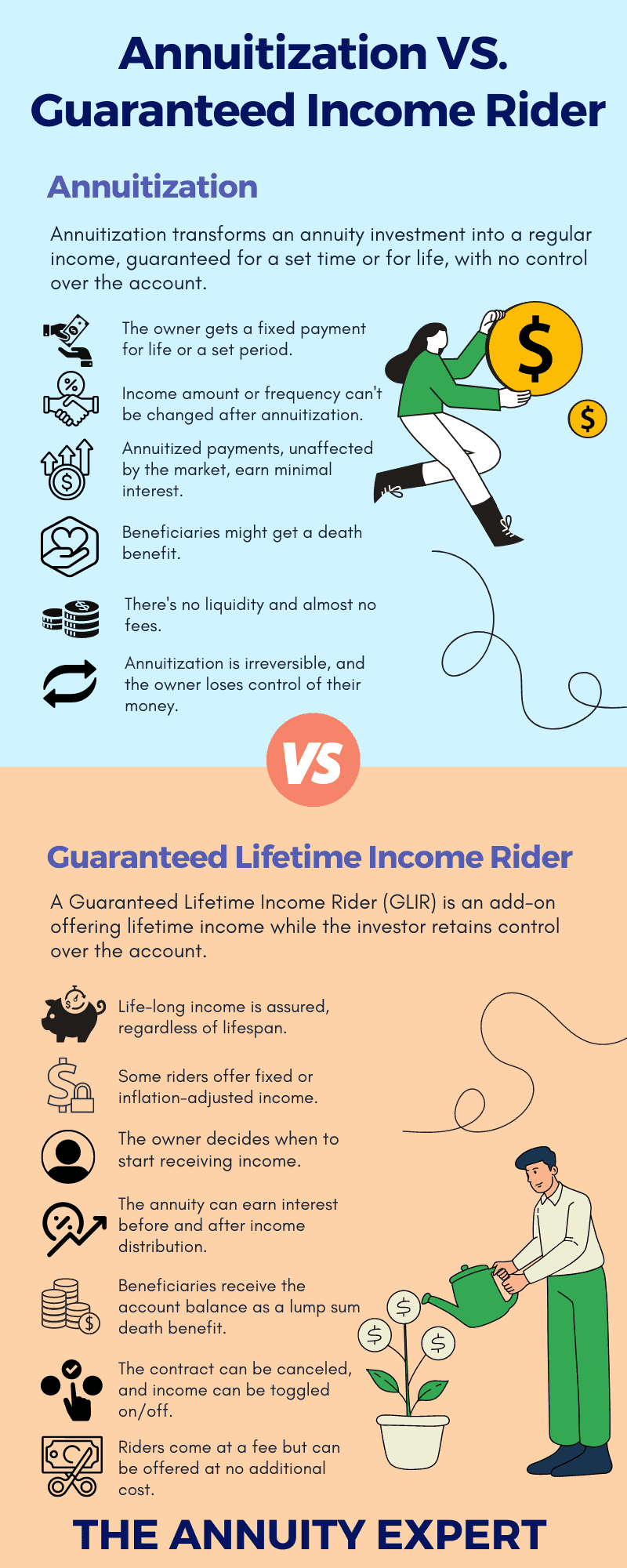
Choosing Whether to Annuitize: How the Income Guarantee Changes the Decision
You Keep Control of Your Money
When you don’t annuitize an annuity, your contract remains in force and fully under your control. You can access the accumulation value, take withdrawals, transfer the annuity to another carrier (1035 exchange), or begin lifetime income using a Guaranteed Lifetime Withdrawal Benefit (GLWB) rider—if included. This flexibility allows you to use the annuity on your own terms without locking into an irreversible payout schedule.
You Can Still Receive Lifetime Income Without Annuitizing
Many annuities include an income rider (GLWB) that lets you take lifetime income while maintaining access to your money. This is often a superior alternative to annuitization because:
- You keep access to the account value
- You can stop and start income as needed
- Your beneficiaries receive the full remaining value upon death
- You are not forced into a one-size-fits-all payout structure
Compare Lifetime Income Without Annuitization
Why a GLWB Beats Annuitization
- Control: You keep the account, can stop/start within rules, and retain a death benefit.
- Flexibility: Adjust timing and strategy; you aren’t stuck with one payout forever.
- Legacy: The remaining value goes to beneficiaries, and spousal continuation options are common.
- Reality check: Annuitization is irreversible. GLWBs are revocable income features with rules—get them explained in writing.
You Maintain Death Benefit Protection
If you choose not to annuitize, your beneficiaries will receive the full accumulation value of the annuity upon your death. With annuitization, the remaining value may be forfeited depending on the annuity payout option selected (e.g., life-only vs. period certain). Avoiding annuitization helps preserve your estate and legacy.
After the Surrender Schedule Ends vs. Maturity Date
It’s important to distinguish between the end of the surrender schedule and the contract’s maturity date:
- Surrender Schedule Ends: This is when surrender charges no longer apply. At this point, you can access the full accumulation value without penalty, transfer the annuity to a new carrier, or start income with a GLWB.
- Maturity Date: This is the date (typically at age 95–100) when the contract requires action—usually either annuitization or a lump-sum distribution. If you don’t make a decision, the carrier may automatically annuitize the contract. To avoid this, you can roll over the funds to a new annuity before the maturity date.
Important Realities to Factor In
- Surrender Charges And MVA:
What to know: Early, large withdrawals during the surrender period can trigger charges; Market Value Adjustment (MVA) can help or hurt depending on rates. These provisions are normal and protect the overall pool of policyholders. - RMDs:
What to know: Qualified annuities must meet Required Minimum Distributions based on current IRS rules. GLWBs and RMDs can be coordinated to avoid conflicts. Plan your withdrawal pattern early. - Death Benefits And Spousal Continuation:
What to know: Deferred annuities typically pay a lump-sum death benefit to beneficiaries and can allow spousal continuation. Annuitization can reduce flexibility—another reason many prefer GLWBs over irrevocable payouts. - After The Surrender Period Matures:
What to know: You can 1035 to a new annuity, renew into a new term, start GLWB income, begin systematic withdrawals, or reposition to other solutions (including LTC or life-based strategies). Don’t default into low crediting or high fees—shop hard. - Funding Sources You Can Use:
What to know: Non-qualified cash, IRAs, 401(k), 403(b), 457(b), TSP, pension lump sums, and 1035 exchanges from other annuities or life insurance. Rollovers and exchanges must be executed correctly to preserve tax advantages. - Waivers For Life Events:
What to know: Many contracts include waivers (nursing home, terminal illness, confinement, ADL triggers) that can increase access without charges. Understand your policy’s triggers before you take action.
Strategic Flexibility
By not annuitizing:
- You preserve control and liquidity
- You avoid locking into a fixed income stream
- You keep your income strategy flexible and revocable
- You retain full death benefit protection
Bottom Line
Annuitization is irreversible and often not in your best interest. Most of our clients prefer income riders or strategic withdrawals that provide guaranteed income without sacrificing access to their money. If your annuity is nearing the end of its surrender period or approaching maturity, we can help you review your options and potentially move into a better-performing contract.
Let us compare your current annuity with newer options offering better income, higher growth potential, and continued flexibility—all without giving up control.
Book A Free Consultation
Get help from a licensed financial professional. This service is free of charge.
Let Us Answer Your Questions
Not quite ready for a meeting, but you have a question that needs answering? We’re happy to help. Leave an inquiry below, and one of our staff will respond via email.
Questions From Our Readers
What is the nonforfeiture value of an annuity before annuitization?
The minimum value you’re entitled to if you surrender: typically, account value minus applicable charges, respecting state nonforfeiture laws.