

Why This Decision Matters
Many retirement plans, annuities, and even the lottery make you choose: take a lump sum payout or convert it into lifetime income (called “annuitization”). This choice determines your control, tax treatment, income security, and legacy. Once you annuitize, it’s permanent—there’s no going back.
But there’s a smarter middle path: roll your lump sum into an IRA annuity with a Guaranteed Lifetime Withdrawal Benefit (GLWB). This strategy gives you contractually guaranteed lifetime income like an annuity, plus the flexibility, interest-earning ability, and inheritance benefits of a lump sum.
Annuity Vs. Lump Sum Calculator
Use this lump sum vs. annuity payout calculator to compare taking a one-time payout against choosing a lifetime income stream. Before deciding, review the IRA annuity with a Guaranteed Lifetime Withdrawal Benefit (GLWB) option below—it offers the flexibility of a lump sum and the security of guaranteed lifetime income, giving you the best of both worlds for retirement.
Turn your years of hard work into a guaranteed paycheck—let us find the highest-paying pension annuities for your retirement for free.
The Lump Sum Payout Option
How it works: You withdraw your entire account balance at once. You can take it in cash (and pay taxes immediately) or roll it into an IRA to stay tax-deferred.
Pros:
- Complete control over your money
- Can invest, spend, or transfer as you wish
- Leaves a legacy for heirs
Cons:
- No contractually guaranteed lifetime income
- You bear all market and longevity risks
- Easy to overspend or mistime investments
- Who needs it: Investors who want maximum flexibility and can manage withdrawals responsibly.
- Who doesn’t: Anyone needing a predictable monthly income or protection from market loss.
Tax Warning: If you are planning to cash out your lump sum rather than turn it into income, the tax bill can be shocking. Use our guide to calculate tax on a lump sum payment to see exactly how much you will keep after federal and state taxes are deducted.
Annuity Payout Option (Annuitized Payments)
How it works: You exchange your account balance for fixed monthly payments guaranteed for life. These payments stop at death unless you add a joint or period-certain option.
Pros:
- Contractually guaranteed lifetime income
- No market or investment risk
- Simple, predictable budgeting
Cons:
- Irreversible decision
- No liquidity or control once annuitized
- Little or no legacy value for heirs
- Who needs it: Those who value a permanent paycheck and don’t need access to principal.
- Who doesn’t: Anyone who values flexibility or wants to pass money to beneficiaries.
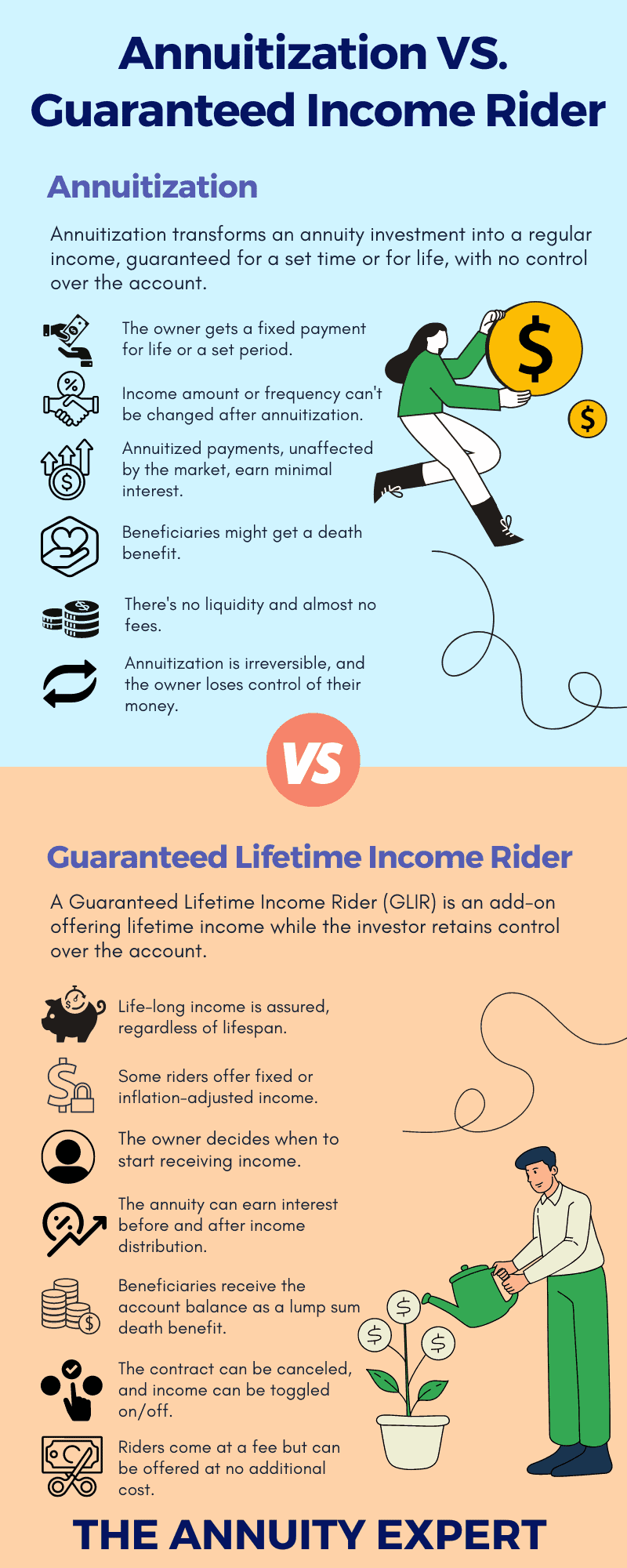
IRA Annuity with a GLWB Option (The Best of Both Worlds)
How it works: You roll your lump sum payout option into an IRA or non-qualified annuity and buy a Fixed Indexed Annuity (FIA) or Variable Annuity with a Guaranteed Lifetime Withdrawal Benefit (GLWB). The result is you maintain control of your account, but your income is guaranteed for life.
Pros:
- Lifetime income without losing control of your money
- Tax-deferred growth and income flexibility
- Beneficiaries inherit the remaining value after death
- Optional income increases to offset inflation
Cons:
- Who needs it: Anyone seeking lifetime income, flexibility, and legacy protection.
- Who doesn’t: People needing immediate access to the full balance.
Understanding the Trade-Off
Every payout option comes down to one key decision: Do you want control or guarantees—or both?
The table below highlights how each option compares:
| Feature | Lump Sum | Annuitized Payout | IRA Annuity with GLWB |
|---|---|---|---|
| Lifetime Income | ❌ | ✅ | ✅ |
| Liquidity & Control | ✅ | ❌ | ✅ (limited) |
| Tax Flexibility | ✅ | ❌ | ✅ |
| Legacy for Heirs | ✅ | ❌ | ✅ |
| Inflation Protection Options | Optional (investments) | Rare | Optional (income increases) |
| Risk Level | Market-dependent | None | Low to moderate (protected growth) |
The GLWB rollover option clearly blends the best of both worlds: a personal pension that you still own, rather than one that disappears after you pass away.
Real-Life Example: How It Works in Practice
Example:
Susan, age 62, was offered a $500,000 lump sum or $2,500 per month for life from her pension. She wanted a reliable income but didn’t like the idea of losing control of her principal.
Instead of taking either extreme, she rolled her lump sum into an IRA Fixed Indexed Annuity with a Guaranteed Lifetime Withdrawal Benefit (GLWB). She deferred income until 65, letting her future payout grow.
Now, she’ll receive a contractually guaranteed lifetime income check for her and her husband, can access funds if needed, and any remaining balance will go to her heirs. This option gave her the income security of an annuity with the freedom of a lump sum.
Tax Considerations
Taxes are one of the most overlooked—but critical—factors when choosing between payout options.
- Lump Sum:
If taken in cash, you’ll owe ordinary income tax immediately on the entire distribution. Rolling it into an IRA defers taxes until you make withdrawals later. - Annuity Payout:
Payments are taxed as ordinary income each year you receive them. You lose flexibility to control when taxes apply. - IRA Annuity with GLWB:
The lump sum can be rolled over tax-free into an IRA annuity, allowing your money to grow tax-deferred. Taxes only apply when you withdraw income, giving you control over timing and tax efficiency.
When Should You Start Taking Income?
The right time depends on your age, income needs, and whether you plan to keep working.
If you can delay income for several years, rolling to an IRA annuity with a GLWB can increase your payout rate substantially. The longer you defer withdrawals, the higher your lifetime income base grows.
- Immediate Need for Income: Consider a level GLWB payout or a fixed annuitized pension.
- Retiring Within 5–10 Years: Choose a deferred GLWB IRA annuity. It offers a higher guaranteed income the longer you wait.
- Still Working: You can roll your lump sum to an IRA now and activate income later without losing flexibility.
This flexibility makes a GLWB annuity ideal for retirees who don’t want to rush an irreversible decision.
Key Takeaways
- Annuitization is permanent. Once chosen, you can’t reverse it.
- A lump sum offers control but no guaranteed income.
- An IRA annuity with a GLWB offers lifetime income, growth potential, and liquidity—the best of both worlds.
This approach protects your retirement from market downturns while preserving flexibility and leaving something behind for your loved ones.
Strategic Insight: The math is only half the decision. Even if the pension pays slightly more, you lose control of the asset. Read our guide on should I take the lump sum to understand the hidden risks of leaving your money with your former employer.
Related Insurance That Can Help
- Life Insurance: Covers legacy needs if you choose a single-life annuity.
- Long-Term Care Insurance or Annuities with LTC Riders: Protects against significant health costs not covered by Medicare.
- Disability Insurance (pre-retirement): Protects your ability to earn income before the pension kicks in.
How The Annuity Expert Helps
We’re an independent annuity brokerage and insurance agency licensed in all 50 states. We help you:
- Our brokers help compare lump sum and annuity payout options
- Find top-rated IRA annuities with GLWBs
- Match carriers (A- or better AM Best) to your retirement goals
- Understand tax implications and rollover rules
Get free quotes today. Contact The Annuity Expert at 770-755-1565 or request quotes online to see how an IRA annuity with a GLWB can deliver lifetime income and preserve your legacy.

Book A Free Consultation
Get help from a licensed financial professional. This service is free of charge.
Let Us Answer Your Questions
Not quite ready for a meeting, but you have a question that needs answering? We’re happy to help. Leave an inquiry below, and one of our staff will respond via email.
Questions From Our Readers
What is a pension?
A pension is a retirement plan that provides employees with a monthly income after retirement. It’s usually based on factors like years of service and salary. Employers fund pensions, and sometimes, employees contribute as well. There are two main types: defined benefit plans, which promise a specific payment upon retirement, and defined contribution plans, where the payout depends on how much was contributed and the plan’s investment performance. Pensions are less common today, often replaced by 401(k) plans.
How does a pension work?
A pension plan provides retirement income based on your salary and length of service. Employers usually fund these plans, and you receive a monthly payment after retirement. Some plans allow employee contributions and offer options like early retirement or lump-sum payouts. The benefits depend on the plan’s rules and your employment details.
What is the difference between a pension and an annuity?
A pension is an employer-provided retirement plan that offers employees a predetermined monthly income in retirement, based on salary and years of service. On the other hand, an annuity is a financial product purchased from an insurance company that provides a stream of payments in exchange for an initial investment. While pensions are funded and managed by employers, annuities are personal investments that individuals choose to buy. For a complete breakdown of the pros, cons, and income differences in the annuity vs pension debate, see our dedicated comparison guide.
Can I borrow against my union annuity?
The ability to borrow against a union annuity depends on the specific terms and rules set by the union that administers the annuity. Some union annuities may allow loans against the accrued value, while others may not. It’s important to check directly with your union’s benefits administrator or refer to your annuity plan’s documentation to understand the specific loan provisions.
Is a pension good or bad?
A pension can be good because it guarantees a lifetime income, ensuring financial stability. However, it may lack flexibility and growth potential compared to other investments.
Is a pension considered earned income?
No, a pension is not considered earned income. It is retirement income, which can be more favorably taxed in certain states compared to earned income.
Can you roll over a pension into an annuity?
Yes, you can roll over a pension into an IRA annuity, allowing for a steady income stream during retirement.
Can pensions be rolled into an IRA?
Yes, pensions can be rolled into an IRA, allowing for potential tax-deferred growth and more control over investment choices.
Do pensions earn interest?
No, pensions do not earn interest. They provide fixed payments based on your employment terms.
Are pensions paid out for life?
Yes, pensions are typically paid out for life, providing a regular income throughout retirement.
Are pension death benefits taxable?
Yes, pension death benefits are generally taxable as income to the beneficiary.
Is a pension the same as an annuity?
No, a pension is not the same as an annuity. However, pensions often use annuities to distribute retirement payments.
Can I sell my pension annuity?
Yes, you can sell your pension annuity payments through a broker like The Annuity Expert.
Should I take lump sums or annuities from my 401(k) and pension? I’m 38 with $278K in my 401(k), a projected $3M at retirement, and a pension worth $1.7M. I want zero debt, a steady income, and asset protection. What’s the better option?
At your age, with strong savings habits and a generous employer match, you’re on track for a secure retirement. Taking lump sums gives you control, growth potential, and flexibility, but it also means managing market risk and withdrawals for life. Annuities—especially those with guaranteed lifetime income riders (GLWBs)—can protect against annuitization, which is irreversible and lacks flexibility in death benefit options. Many in your position use deferred income annuities or fixed indexed annuities with income riders in their late 50s to guarantee income while investing the rest of their assets more aggressively. Since your goal includes protecting assets and passing wealth to your children, consider pairing income annuities with life insurance. Watch for pension plan changes, inflation risk, and how your income will impact taxes and Medicare in retirement.
Is a pension’s monthly benefit paid directly from the pension fund or from an annuity purchased from an insurance company?
It depends on the pension plan. Many pensions pay benefits directly from the pension fund for the retiree’s lifetime. However, some plans purchase a group annuity from an insurance company to cover the payments, especially for survivor benefits or when the plan offloads its obligations. In those cases, the insurance company takes over payment responsibility, but the monthly benefit to the retiree remains the same.
When does it make sense to have an annuity in addition to pensions and Social Security?
If pension and Social Security benefits cover your essential expenses, the need for an annuity is reduced. But if those income sources fall short, an annuity can fill the gap with contractually guaranteed payments, ensuring a stable income floor. Survivor benefit annuities—like the one tied to your husband’s pension—can serve as a long-term safety net. However, the lack of cost-of-living adjustments means inflation will reduce purchasing power over time. The decision often comes down to whether your guaranteed income sources meet your needs both now and in the future.
How much annuity does $20k buy?
At age 65, ,000 buys around 0 monthly for life in a SPIA. Deferring increases payouts.