

Understanding the Two Risk-Control Features in Registered Index-Linked Annuities
Registered Index-Linked Annuities (RILAs) are designed for people who want growth tied to stock market performance but need protection against losses. Two key features—buffers and floors—limit downside risk in different ways. Knowing the difference helps you choose the right protection for your retirement strategy.
Product Guide Note: If you are looking for a complete, high-level structural definition of how these assets accumulate wealth, or wanting to evaluate the foundational rules of a registered index linked annuity, explore our comprehensive master guide before analyzing these specific downside containment features.
How Buffers Work
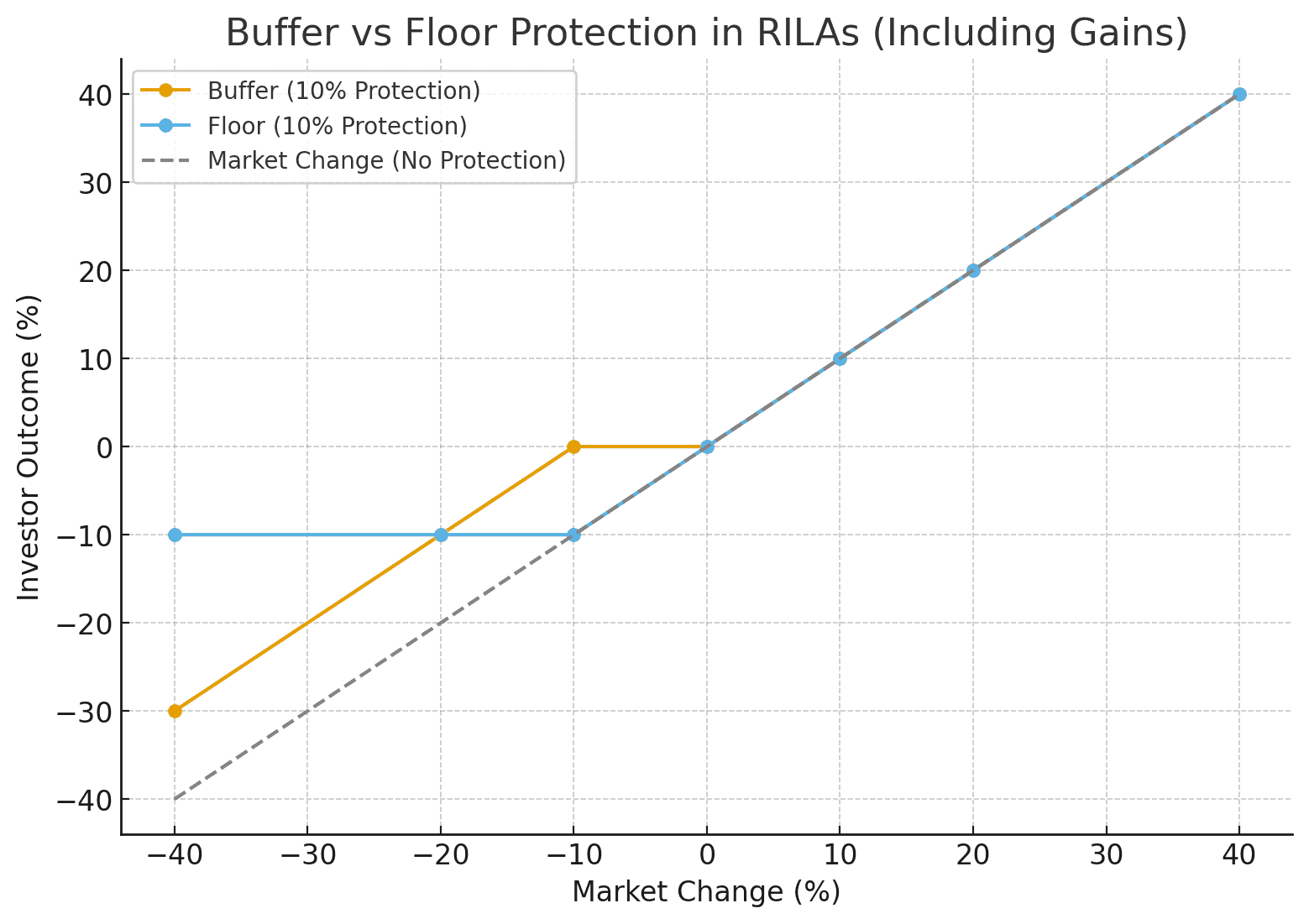
A buffer absorbs the first portion of losses while leaving you responsible for anything beyond that protection.
- Example: If the buffer is 10% and the market falls 25%, the insurer absorbs the first 10%. You lose the remaining 15%.
Pros
- Higher caps and participation rates compared to floor strategies.
- Protects against small-to-moderate downturns.
Cons
- Doesn’t shield against steep losses.
- No guaranteed maximum loss.
What You Give Up
By choosing a buffer, you trade stronger downside protection for higher growth potential.
How Floors Work
A floor sets a hard limit on how much you can lose, no matter how severe the market drop is.
- Example: With a 10% floor, if the market falls 40%, your maximum loss is still only 10%.
Pros
- Predictable maximum loss, even in severe bear markets.
- Provides stronger capital preservation.
Cons
- Lower growth potential since caps and participation rates are usually smaller.
- Less appealing in strong bull markets.
What You Give Up
By choosing a floor, you give up some upside growth in exchange for guaranteed downside limits.
Buffer vs. Floor: Side-by-Side Comparison
| Market Change | Buffer (10% Protection) | Floor (10% Protection) |
| -10% | 0% loss (protected) | -10% (max floor loss) |
| -20% | -10% loss | -10% (max floor loss) |
| -40% | -30% loss | -10% (max floor loss) |
| +20% | +20% gain (subject to cap/participation) | +20% gain (subject to cap/participation) |

Suitability Snapshot
- Buffer May Be Best For:
- Mid-career investors who have time to recover from losses.
- Those seeking higher growth potential and willing to accept more downside risk.
- Floor May Be Best For:
- Near-retirees or retirees who need certainty about their worst-case scenario.
- Risk-averse investors who prioritize capital preservation.
- Who Should Avoid RILAs?
- People needing complete downside protection (better served by Fixed Indexed Annuities).
- Those unwilling to accept market losses.
Real-Life Scenarios
- Investor A (Age 60): About to retire, chooses a floor to cap losses at 10% and protect their nest egg from severe downturns.
- Investor B (Age 45): Has 20 years until retirement, chooses a buffer to accept some downside in exchange for higher upside potential.
Understanding Caps and Participation Rates
- Cap Rate: The maximum percentage gain credited in a period.
- Participation Rate: The percentage of the index’s gain you receive.
Key Trade-Off: Buffers usually come with higher caps and participation rates than floors because you’re accepting more downside risk.
What Happens After the RILA Term Ends
At the end of the surrender period, you can:
- Renew the contract with new caps and rates.
- Reallocate strategies (switch between buffer and floor).
- Withdraw funds without surrender charges.
- Take advantage of liquidity features like penalty-free withdrawals.
If you do nothing, many contracts automatically reallocate based on the insurer’s default option.
Historical Context
RILAs became popular after the 2008 financial crisis, offering a middle ground between Fixed Indexed Annuities (FIAs), which have no market losses, and Variable Annuities (VAs), which offer full exposure to both gains and losses.
Compare RILAs to Other Annuities
- RILA vs. FIA: RILAs allow some losses but usually have higher growth caps. FIAs never lose value in down markets (floor of 0%).
- RILA vs. Variable Annuity: RILAs reduce downside risk but limit upside. VAs offer unlimited growth but full downside risk.
- RILA vs. Fixed Annuity/MYGA: Fixed annuities offer contractually guaranteed returns but no market growth potential.
Regulatory Notes and Risks
- RILAs are securities, regulated by the SEC and FINRA.
- Losses in a RILA are real, unlike FIAs, where the worst you can earn is 0%.
- State guaranty associations may provide limited protection if the insurer fails, but coverage amounts vary by state.
Other Insurance Alternatives to Compare
- Fixed Indexed Annuities (FIAs): Protect against all losses with capped upside.
- Immediate or Deferred Income Annuities (SPIAs/DIAs): Provide contractually guaranteed lifetime income.
- Life Insurance: Protects your family if market losses reduce your account value.
- Long-Term Care Insurance: Keeps medical costs from draining your retirement income.
Bottom Line
RILAs limit losses through buffers and floors, but the trade-offs are very different. Buffers allow for higher growth but expose you to deeper losses. Floors reduce growth potential but give you certainty about maximum losses.
Contact The Annuity Expert today for free quotes to compare RILAs with buffers and floors and find the best fit for your financial goals.
Book A Free Consultation
Get help from a licensed financial professional. This service is free of charge.
Let Us Answer Your Questions
Not quite ready for a meeting, but you have a question that needs answering? We’re happy to help. Leave an inquiry below, and one of our staff will respond via email.
Questions From Our Readers
Can I lose all my money in a RILA?
No, but you can lose more than you would in a Fixed Indexed Annuity. Your losses depend on whether you choose a buffer or a floor and the contract terms.
Do RILAs guarantee lifetime income?
Not by default. They’re primarily growth products. For lifetime income, you’d need to add an income rider or compare them to annuities with GLWBs
What happens if the insurer fails?
Policyholders are usually protected up to state guaranty limits, but it’s important to work with highly rated insurers.