

Why “Annuity” Does Not Always Mean an Immediate Pension Check
Many people hear “annuity” and assume it means only an immediate income product, like a SPIA. That’s wrong—and it causes a lot of bad decisions. Fixed indexed annuities (FIAs) and immediate annuities are completely different tools that just share the same label.
Below is a direct, no-fluff comparison for U.S. residents.
What Each Annuity Type Actually Is
Fixed Indexed Annuity (FIA)
Basic definition: A fixed indexed annuity is a deferred annuity that protects principal and credits interest based on either a fixed rate or a market index formula.
Core features:
- Type of annuity: Deferred
- Growth source: Fixed interest or index-linked interest
- Market loss risk: None on principal or previously credited interest
- Income options: GLWB rider or annuitization (annuitization not recommended because it is irreversible)
- Role in a plan: Long-term growth and future income flexibility
How it works:
- Premium: You pay a lump sum (or flexible premiums).
- Accumulation: Your money grows tax-deferred using a fixed rate or index strategy.
- Protection: If the index is negative, you don’t lose principal or credited interest.
- Income: Later, you can add or use a Guaranteed Lifetime Withdrawal Benefit (GLWB) to create lifetime income without giving up full control.
Immediate Annuity (SPIA)
Basic definition: A single premium immediate annuity converts a lump sum into contractually guaranteed income starting within 12 months of purchase.
Core features:
- Type of annuity: Immediate
- Growth source: None; it’s purely a payout vehicle
- Market loss risk: None, but no growth opportunity
- Income options: Life-only, joint-life, period certain, refund options
- Role in a plan: Immediate paycheck, pension-style income
How it works:
- Premium: You give the insurer a lump sum.
- Payout start: Income starts within 12 months.
- Irrevocability: You usually can’t change or cancel the payments.
- Tax angle: Non-qualified SPIAs can provide income before age 59½ without the 10% early withdrawal penalty.
Why People Mix FIAs and SPIAs Up
Shared label:
- Problem: The word “annuity” is slapped on both products.
- Result: Consumers assume every annuity is a fixed monthly check with no flexibility.
- Both can provide lifetime income:
- FIA income: Comes from a GLWB rider or annuitization.
- SPIA income: Comes from the permanent conversion of your lump sum to payments.
- Confusion: People see “lifetime income” and assume the structure is identical. It isn’t.
- Poor explanations: Marketing often glosses over the differences, leading buyers to think they are rejecting “annuities” when they really only dislike SPIA-style lock-ins.
When comparing fixed indexed annuities with immediate annuities, guaranteed income beginning now is worth comparing against both SPIAs and immediate-withdrawal GLWBs because the highest initial payment is not always the best overall retirement outcome.
How Fixed Indexed Annuities Work (In Plain English)
Growth mechanics:
- Fixed rate option: Earns a declared rate, usually locked in for a year and adjusted annually.
- Index-linked options:
- Common methods: Annual point-to-point, participation rate strategies, and other formulas.
- Upside: You get a portion of index gains.
- Downside: Gains are limited by participation rates/spreads; you don’t get full stock market returns.
Protection:
- Principal: Protected from stock market losses.
- Credited interest: Locked in once earned.
- Worst-case scenario in a bad year: You earn 0% instead of losing money.
Income options later:
- GLWB rider:
- Function: Lets you take a contractually guaranteed percentage (often 5–8%) of an income base for life.
- Inflation options: Can be level or increasing (fixed step-ups, index-credit-based increases, or CPI-linked increases, depending on the annuity).
- Annuitization: Always an option, but we generally do not recommend it because it is irreversible and reduces flexibility and legacy options.

How Immediate Annuities Work (In Plain English)
Conversion of lump sum:
- Step 1: You hand the insurer a lump sum.
- Step 2: The Insurer calculates payouts based on age, sex, interest rates, and payout structure.
- Step 3: You receive a fixed income stream.
Payout choices:
- Life only: Highest income, no refund after death.
- Life with a period certain: Income for life, but guarantees payments for a minimum number of years.
- Joint life: Covers two lives (often spouses).
- Refund options: Return-of-premium style benefits for heirs if you die early (usually with lower income).
Key trade-offs:
- Pros: Simple, predictable, often higher pure income than alternatives.
- Cons: No liquidity, no growth, limited or no legacy, depending on options.
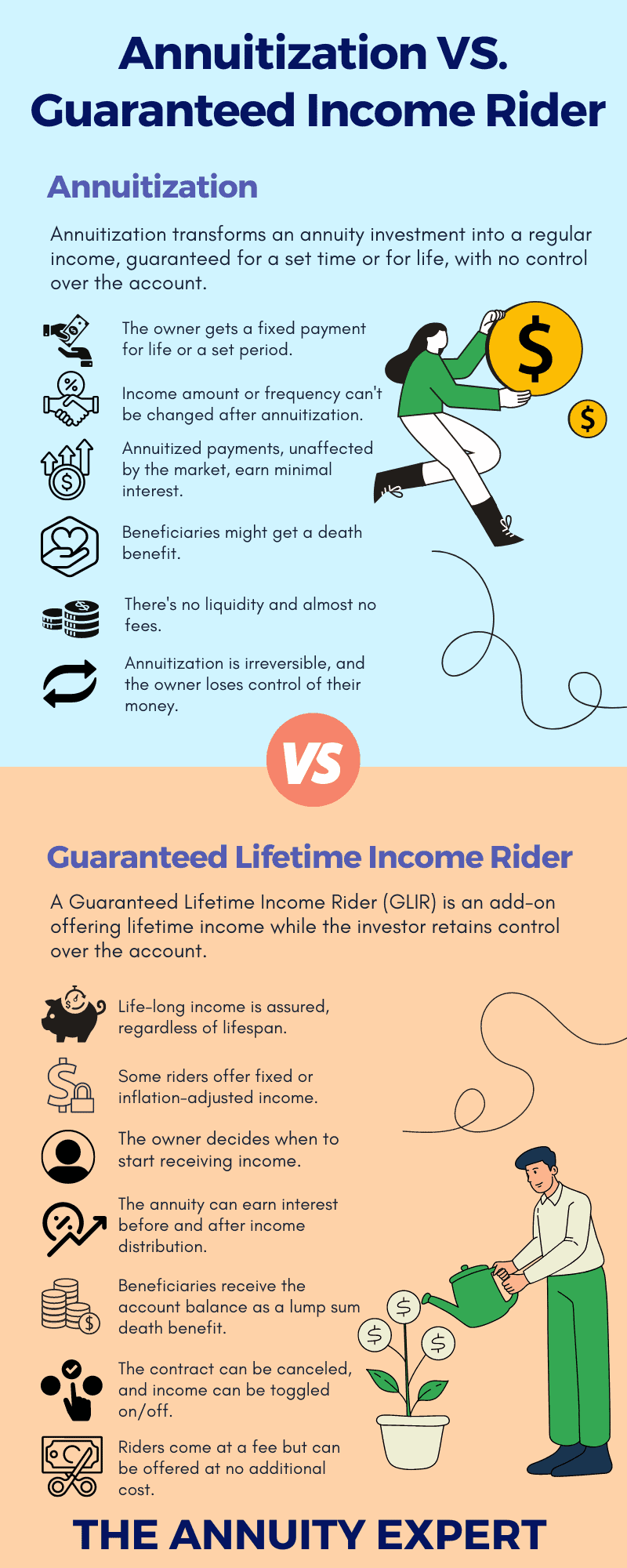
Key Differences Between FIAs and SPIAs
- Purpose:
- FIA purpose: Protect principal, grow over time, and provide flexible future income.
- SPIA purpose: Turn a lump sum into an immediate, stable income.
- Control:
- FIA control: You retain an account value; you can often move or change strategies after the surrender period.
- SPIA control: You give up control of the principal once purchased.
- Liquidity:
- FIA liquidity:
- Penalty-free withdrawals: Typically up to 10% annually after the first year.
- Waivers: Nursing home, terminal illness, or confinement waivers are in many contracts.
- Return of premium features: Some FIAs offer ROP options for extra flexibility.
- SPIA liquidity: Usually none. Income comes as scheduled; no lump-sum access.
- FIA liquidity:
- Growth potential:
- FIA growth:
- Index-linked: Participation in market gains with downside protection.
- Fixed rate option: Stable but limited.
- SPIA growth: None: Payments focus on income, not asset growth.
- FIA growth:
- Legacy:
- FIA legacy:
- Beneficiaries: Receive the remaining account value at death.
- SPIA legacy:
- Life-only: Often, nothing is left.
- Refund or period-certain options: Can leave something, but at the cost of lower income.
- FIA legacy:
- Inflation impact:
- FIA inflation:
- Mitigation: Increasing GLWBs, continued index-linked growth, and flexible withdrawal strategies.
- SPIA inflation: Problem: Payments are usually fixed, so purchasing power erodes over time.
- FIA inflation:
Pros and Cons of Fixed Indexed Annuities
Pros:
- Principal protection: Shields savings from market losses.
- Tax deferral: Delays taxes on growth until you withdraw.
- Growth potential: Index-linked returns plus a fixed rate option.
- Income flexibility: GLWB riders offer lifetime income without surrendering control.
- Legacy: Remaining value passes to heirs.
- Liquidity: Penalty-free withdrawals and waivers during the surrender period.
Cons:
- Limited upside: Participation rates and spreads cap your gains.
- Complexity: Crediting methods and riders can be confusing.
- Surrender charges: Long-term commitment with penalties for large early withdrawals.
- Rider fees: Income riders and other add-ons cost money.
Pros and Cons of Immediate Annuities (SPIAs)
Pros:
- High pure income: Mortality credits allow higher payouts than most bonds.
- Simplicity: Easy to understand—pay a premium, receive income.
- Penalty relief: Non-qualified SPIAs can provide income before 59½ without a 10% penalty.
- No ongoing fees: Payout structure is baked into the pricing.
Cons:
- Irreversible: Once purchased, contracts generally cannot be changed.
- No liquidity: You can’t access a lump sum.
- No growth: Payments are fixed; no future upside.
- Weak legacy value: Life-only designs can leave nothing for heirs.
- Inflation risk: Purchasing power steadily erodes.
Who Should Consider Fixed Indexed Annuities
Ideal buyers:
- Age group: Typically late 40s through 70s.
- Goals:
- Need: Principal protection.
- Need: Long-term growth above CDs.
- Need: Future lifetime income with flexibility.
- Need: Legacy value for heirs.
- Profile: Cautious investors who dislike stock market losses but still want better-than-CD potential.
Who may not need FIAs:
- Short-term savers: People who need full access to funds in a few years.
- Aggressive investors: Those comfortable with full stock market risk for maximum upside.
- Cash-only mindset: Those who refuse any surrender period or contractual commitment.
Who Should Consider Immediate Annuities
Ideal buyers:
- Early retirees: Especially those under age 59½ using non-qualified funds to avoid the 10% IRS penalty while generating income.
- Income-focused retirees: Those who want a simple, predictable paycheck and are willing to sacrifice flexibility.
- People with other assets: Those who can afford to carve off a portion for lifelong income and still maintain liquid investments elsewhere.
Who may not need SPIAs:
- Legacy-focused households: Those who want to leave larger inheritances.
- Liquidity-conscious retirees: People who want access to principal.
- Inflation worries: Those concerned about rising costs eroding a fixed payment.
When Early Retirees vs. Older Retirees Should Choose Increasing Income
Early retirees (younger than 65):
- Primary concern: Making income last 20–30+ years.
- Best option:
- Recommendation: Choose an increasing income option (e.g., increasing GLWB or inflation-based SPIA option if available).
- Reason: You need a rising income to keep up with long-term inflation.
Older retirees (age 70 or older):
- Primary concern: Higher income now versus long-term compounding.
- Best approach:
- Recommendation: Weigh a higher starting fixed payment against an increasing option.
- Reason: Time is shorter; an increasing option may never “catch up” if you don’t live long enough.

Other Insurance That Can Help
- Life insurance:
- Use: Protects heirs if you rely on SPIAs or GLWBs for income and spend down assets.
- Who needs it: Married couples, families, and anyone concerned about a surviving spouse’s lifestyle.
- Long-term care insurance:
- Use: Protects income and assets from nursing home and home-care costs.
- Who needs it: Middle-class and affluent households who can’t afford to self-insure care costs comfortably.
- Disability insurance (for pre-retirees):
- Use: Protects income before retirement so you can keep funding savings and annuities.
- Who needs it: Anyone still working and relying on earned income.
- Medigap and Medicare-related coverage:
- Use: Reduces out-of-pocket medical costs that can eat into annuity income.
- Who needs it: Retirees on Medicare who want stable healthcare expenses.
Why Many People Should Use FIAs Instead of SPIAs (Or Blend Them)
- FIA with GLWB:
- Gives: Contractually guaranteed lifetime income, growth potential, and better legacy options.
- Keeps: Control and flexibility.
- SPIA only:
- Gives: Simple, predictable income.
- Takes away: Flexibility, liquidity, and often a meaningful legacy.
In many cases, an FIA with a well-designed GLWB and proper planning will deliver more flexibility and better long-term outcomes than locking everything into an SPIA.
Compare Annuity Quotes Before You Commit
Plain truth: If you buy the wrong annuity, you’re stuck with it. Most buyers never see all their options or understand the trade-offs
Next step:
Contact The Annuity Expert for free quotes to compare fixed indexed annuities and immediate annuities side by side. We help you:
- Compare: Benefits, guarantees, and fees across multiple insurers.
- Decide: How much (if any) should go into SPIAs versus FIAs with GLWBs.
- Protect: Income, spouse, and legacy at the lowest reasonable cost.
You can also ask your current insurance agent to help evaluate an in-force policy, or contact us directly for an independent, side-by-side comparison.
Book A Free Consultation
Get help from a licensed financial professional. This service is free of charge.
Let Us Answer Your Questions
Not quite ready for a meeting, but you have a question that needs answering? We’re happy to help. Leave an inquiry below, and one of our staff will respond via email.
Questions From Our Readers
How do I know if I’m being sold the wrong annuity?
Red flags include salespeople pushing a single product, failing to compare alternatives, or dismissing your questions about liquidity, fees, or legacy. If no one shows you multiple carriers, explains GLWB vs. SPIA clearly, or walks through trade-offs, assume you’re not getting the full picture and get an independent comparison from The Annuity Expert.
Which is better for someone worried about inflation?
FIAs with increasing GLWBs generally offer better inflation protection because income can step up when the index credits interest. SPIAs are usually level, so purchasing power drops over time. Some SPIAs offer inflation adjustments, but the starting income is typically much lower, and these options are limited and expensive.
Can I use both an FIA and an SPIA in the same plan?
Yes. Some people use a SPIA for a base income floor—especially when retiring early with non-qualified money—and use a FIA with GLWB for supplemental lifetime income and growth potential. This blend can provide immediate income, inflation-sensitive income, and better legacy value when structured correctly.
Why do most people think all annuities are SPIAs?
Historically, most education on annuities focused on immediate income products that look like pensions. Because they’re easy to explain—lump sum in, paycheck out—many people assumed that’s the only type. FIAs, DIAs, MYGAs, and variable annuities are all annuities, but they function very differently.
Is a fixed indexed annuity safer than an SPIA?
They are both backed by the insurer’s financial strength, but “safer” depends on what you mean. FIAs protect principal and keep an account value you can access or pass on. SPIAs protect income but sacrifice liquidity and often legacy. For many people, that loss of control feels less safe, even if payments are guaranteed.