

North American Income Pay Pro Overview
A competitive lifetime-income annuity with useful payment flexibility, but weak accumulation potential and a rider fee that grows with the income value.
The North American Income Pay Pro 10 is a fixed indexed annuity designed primarily to create guaranteed lifetime retirement income. It includes an embedded guaranteed lifetime withdrawal benefit, principal protection from negative index performance, level and increasing income choices, a nursing-home income multiplier, and an LPA reserve that lets the owner save part of a scheduled payment for later.
Income Pay Pro 10 is an income annuity first and an accumulation annuity second. The reason to purchase it is the lifetime paycheck. The fixed and indexed accounts may help the remaining account value last longer, but they are not strong enough for us to recommend the product when maximum safe growth is the primary goal.
Our Professional Opinion on the North American Income Pay Pro 10 Annuity
We recommend the North American Income Pay Pro 10 when its actual guaranteed lifetime-income payout is competitive with the other A- or better-rated income annuities available for the buyer’s age, state, premium, and desired income start date.
North American is generally competitive in the lifetime-income market, and Income Pay Pro 10 is a good product for the job it is designed to do. We would include it in a serious income comparison, especially for buyers who value a guaranteed compound roll-up, flexible payment timing, joint-life coverage, and the ability to reserve part of a scheduled payment for later.
The rider design is one of the strongest parts of the product. The separate GLWB value receives contractually guaranteed compound growth while income is deferred, subject to the rider’s time limits and withdrawal rules. That gives the buyer more certainty than a performance-based income rider where the future paycheck depends heavily on index returns and future renewal rates.
We would rather know how the income calculation value is guaranteed to grow than cross our fingers and hope an engineered index performs as illustrated.
However, a large GLWB value does not automatically make Income Pay Pro 10 the best annuity. The GLWB value is a calculation value, not cash. It cannot be surrendered, withdrawn as a lump sum, or paid as the standard death benefit.
The only number that ultimately matters is the actual guaranteed annual income. If North American guarantees one of the strongest payouts available, we recommend the product. If another financially strong insurance company pays materially more from the same premium, we would choose the higher-paying annuity.
The accumulation side is not great. The traditional S&P 500 and fixed-account options are not the reason we would buy this annuity. Much of the larger-looking upside is concentrated in engineered, volatility-controlled, or excess-return indexes.
Those headline participation rates cannot be compared directly with a traditional S&P 500 cap. Several of the proprietary indexes use volatility controls, cash allocations, excess-return calculations, internal deductions, or dynamic asset-allocation rules that can materially reduce performance.
The traditional S&P 500 rates, engineered-index participation rates, and fixed-account rate can also change when the applicable crediting term renews. Income Pay Pro 10 is not a cap-lock annuity.
If protected accumulation is the primary objective, we would compare products with a locked cap on a transparent traditional index or a MYGA with a contractual fixed rate. Income Pay Pro should be purchased for income—not because the buyer expects top-tier account-value growth.
The annual GLWB charge also deserves attention. It is calculated using the GLWB value and deducted from the accumulation value. Because the GLWB value can grow faster than the actual cash value, the dollar amount of the annual charge can become meaningful over time.
The charge continues after lifetime payments begin, in years when the contract earns no interest, and during years when withdrawals are taken. We are comfortable paying the fee when North American delivers a competitive lifetime payout. We are not comfortable paying it for a middle-of-the-road income quote.
We like the choice between level and increasing income. The level option provides the larger predictable starting payment. The increasing option begins lower and then rises by the annual increase declared when income starts.
The increasing option is not automatically better. The buyer gives up income during the early years and must live long enough for the later increases to make up the difference. We would compare the cumulative income from both choices before selecting the increasing option.
The LPA reserve is one of our favorite features. After lifetime income begins, the owner can take less than the full scheduled payment and move the unused portion into a reserve. That reserve can later be used for a larger withdrawal or a lump-sum expense.
This provides useful flexibility for travel, healthcare expenses, family needs, or years when less taxable income is desired. It is more practical than an income design that forces the owner to take the full scheduled payment every year or permanently lose the unused amount.
The nursing-home multiplier is useful but limited. It can temporarily increase the lifetime payment after the waiting period when the owner satisfies the qualified-care-center requirements. The benefit requires medically necessary confinement, continued proof, and a positive accumulation value when it is elected.
This is not actual long-term care insurance. It does not create a separate pool of benefits for home care, assisted living, or nursing-home expenses. It is a temporary increase to the annuity payment and has narrower qualification rules than dedicated coverage.
Joint coverage is also worth considering. When the contract is established with joint covered persons, the lifetime payment is based on the younger spouse and can continue until the second spouse dies. That can protect the surviving spouse from losing the annuity income after the first death.
However, an individually covered contract works differently after income begins. A surviving spouse may continue the underlying annuity, but the GLWB rider can terminate. Couples who need both lifetimes covered should elect the correct joint structure when the contract is issued.
Income Pay Pro also provides first-year penalty-free access, which is better than many income annuities. The catch is that withdrawals before lifetime income begins proportionally reduce the GLWB value and therefore reduce the future paycheck. Even a withdrawal that avoids surrender charges is not free from income consequences.
Our bottom line: North American Income Pay Pro 10 is a good and generally competitive guaranteed-income annuity. We like the guaranteed compound roll-up, competitive payouts, level and increasing payment choices, LPA reserve, nursing-home multiplier, joint-life option, and strong insurance company. We do not like the weak accumulation potential, engineered-index reliance, GLWB-value-based rider fee, renewal-rate risk, or long surrender period.
Compare Income Pay Pro 10 With the Entire Income Annuity Market
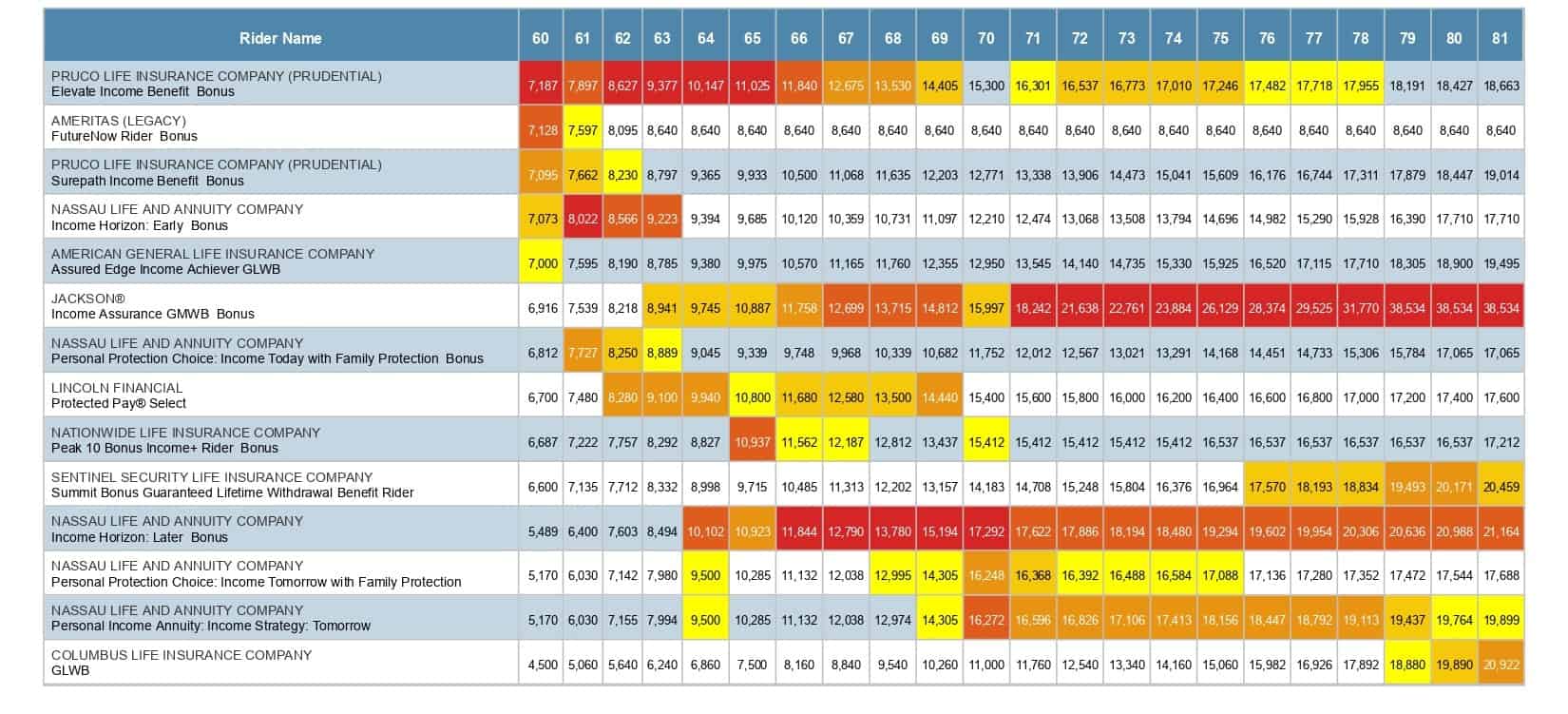
Lifetime-income payouts change as insurance companies adjust product pricing, rider terms, and payout factors. The result depends on age, state, premium, income start date, and whether the income covers one or two lives.
Contact The Annuity Expert for a free custom annuity income heat map based on your actual information. We compare Income Pay Pro 10 with current lifetime-income annuities from A- or better-rated insurance companies.
What We Like
- Generally Competitive Lifetime Income: Income Pay Pro 10 is often worth including in a full-market income comparison.
- Guaranteed Compound GLWB Growth: The income calculation value receives contractual growth while income is deferred, subject to the rider rules.
- Level and Increasing Income: Buyers can choose a larger level payment or a lower starting payment with contractually defined annual increases.
- Income Can Start Relatively Soon: Eligible owners can begin lifetime payments without waiting through the full surrender period.
- Start-and-Stop Flexibility: Lifetime payments can generally be stopped and restarted without traditional annuitization.
- LPA Reserve: The owner can save unused scheduled income and access it later as larger payments or a lump sum.
- Joint Lifetime Coverage: Properly structured joint coverage can continue the established lifetime payment through the surviving spouse’s life.
- Nursing-Home Multiplier: Qualifying confinement can temporarily increase the scheduled lifetime payment.
- First-Year Liquidity: The contract provides penalty-free access to a portion of the accumulation value beginning in the first year.
- True S&P 500 Options: Buyers are not forced to allocate everything to proprietary indexes.
- Principal Protection: Negative index performance does not directly reduce the accumulation value.
- Strong Insurance Company: North American comfortably exceeds our A- minimum financial-strength standard.
What We Don’t Like
- The Payout Still Has to Win: A good rider design does not justify accepting less guaranteed income than another strong insurer will pay.
- The GLWB Value Is Not Cash: It cannot be surrendered, withdrawn as a lump sum, or used as the standard death benefit.
- Rider Fee Based on the GLWB Value: The dollar charge can grow as the income calculation value grows.
- Fee Continues After Income Starts: The charge is deducted in years with lifetime payments, withdrawals, or no credited interest.
- Weak Accumulation Potential: The traditional-index and fixed-account terms are not competitive enough for us to use this as a growth-focused FIA.
- Engineered Index Reliance: Much of the larger-looking upside is tied to volatility-controlled, multi-asset, or excess-return indexes.
- Renewal-Rate Risk: North American can change caps, participation rates, and the fixed-account rate when the applicable term renews.
- No Cap Lock: The traditional S&P 500 rates are not guaranteed for the full surrender period.
- Increasing Income Starts Lower: The owner may spend many years receiving less income before the increases make up the difference.
- Withdrawals Reduce Future Income: Penalty-free withdrawals and RMDs can proportionally reduce the GLWB value before income begins.
- RMD Treatment Is Partly Company Practice: Favorable treatment above the normal free-withdrawal amount is not necessarily a contractual guarantee.
- Nursing-Home Benefit Is Narrow: The multiplier requires qualified facility confinement and is not comprehensive care insurance.
- Long Surrender Period: Excess withdrawals can trigger surrender charges and a Market Value Adjustment for approximately a decade.
- No Return of Premium or Bailout Provision: The contract does not provide an automatic exit if renewal terms become unattractive.
North American Income Pay Pro 10 Product Details
| Product Type | Modified Single-Premium Deferred Fixed Indexed Annuity |
| Primary Purpose | Guaranteed Lifetime Income |
| Issuing Company | North American Company for Life and Health Insurance |
| Issue Ages | Generally ages 40 through 79, subject to state availability |
| Minimum Premium | $20,000 |
| Premium Funding | Initial premium and eligible additional premium during the first contract year |
| Surrender Period | 10 Years |
| Lifetime Income Rider | Embedded Guaranteed Lifetime Withdrawal Benefit |
| GLWB Growth | Contractually guaranteed compound growth for up to the first decade or until income begins |
| Income Start | Available beginning at the rider’s minimum income age |
| Income Options | Level or increasing; individual or joint covered persons |
| Rider Fee | Annual charge based on the GLWB value and deducted from accumulation value |
| LPA Reserve | Yes |
| Nursing-Home Multiplier | Temporary enhancement for qualifying care-center confinement |
| Penalty-Free Withdrawals | Annual access to a portion of beginning-of-year accumulation value starting in year one |
| Market Value Adjustment | Yes |
| Return of Premium | No |
| Bailout Provision | No |
| Death Benefit | Generally the greater of accumulation value or minimum surrender value |
| Company Ratings | A+ from AM Best, Fitch, and Standard & Poor’s in the supplied product materials |
North American is an excellent annuity company. The insurer’s financial strength is not our concern with Income Pay Pro 10. The recommendation depends on whether the actual guaranteed payout is competitive and whether the buyer accepts the rider fee, weak accumulation potential, and long surrender commitment.
Product availability, issue ages, rider terms, index options, and state-specific provisions can change. Review the current illustration, disclosure, and contract before purchasing.
How Income Pay Pro 10 Works
Income Pay Pro 10 tracks two separate values:
- Accumulation Value: The actual contract value used for withdrawals, surrender, the standard death benefit, and annuitization.
- GLWB Value: A separate benefit-base value used to calculate lifetime payments and the annual rider charge.
The accumulation value changes based on premium, interest credits, withdrawals, rider charges, and scheduled income payments.
The GLWB value receives the contractual roll-up before income begins. It is reduced proportionally by withdrawals, including penalty-free withdrawals and RMDs.
The two values can be very different. A large GLWB value can support a strong lifetime payment even when the accumulation value is lower, but the owner cannot withdraw or surrender the GLWB value.
How the Lifetime Payment Is Calculated
The lifetime payment is calculated by applying the contract’s age-based lifetime payment percentage to the applicable GLWB value when income begins.
The payment depends on:
- The premium deposited
- The amount of time income is deferred
- The attained age when income begins
- Whether the payment covers one life or two
- Whether the level or increasing option is selected
- Any withdrawals taken before income begins
Once scheduled lifetime payments begin, they can continue after the accumulation value reaches zero, assuming the owner follows the rider rules and does not take an excess withdrawal.
The lifetime-payment election is not the same as annuitization. The owner retains the remaining accumulation value and can generally stop or restart scheduled payments.
Level Income vs. Increasing Income
Level Lifetime Income
The level option starts with the larger predictable payment and keeps that scheduled amount level for life unless an excess withdrawal reduces it.
This is generally where we begin the comparison when the buyer wants the most guaranteed spendable income immediately.
Increasing Lifetime Income
The increasing option starts with a lower payment. The payment then rises by the annual increase declared when lifetime income begins.
The declared increase is locked after the income election, but the rate available to a future buyer or to an owner who has not yet activated income can change.
Increasing income is a lifestyle choice—not a free improvement. Compare the first-year payment, annual increase, cumulative break-even point, life expectancy, and spending needs before selecting it.
The LPA Reserve
The LPA reserve allows the owner to take less than the full scheduled lifetime payment during a contract year. The unused amount is placed into a reserve, subject to the contract maximum.
The reserve can later be taken gradually or as a lump sum. This can help someone:
- Save part of the retirement paycheck for a future trip or large purchase
- Create a reserve for future medical or family expenses
- Take less taxable income during a lower-spending year
- Receive a temporarily larger payment later
If the accumulation value reaches zero, the remaining LPA reserve is paid as a lump sum and the reserve feature ends. While the accumulation value remains positive, the reserve can also affect the amount payable as the death benefit.
Nursing-Home Multiplier
The nursing-home multiplier can temporarily increase the scheduled lifetime payment after the waiting period when the covered person is confined to a qualified care center and satisfies the rider requirements.
The current brochure requires medically necessary confinement for the required period, written proof, and a positive accumulation value when the multiplier is elected. Continued proof is required for future enhanced payments.
The enhanced payment is available for a limited number of annual payments and does not need to be used in consecutive years.
The limitation is the care trigger. This feature is built around qualified facility confinement. It does not provide the broader home-care flexibility available in many dedicated long-term care policies.
Joint Income and Spousal Continuation
Income Pay Pro 10 can cover an individual or joint covered persons. Joint covered persons must generally be spouses, and the lifetime payment is based on the younger spouse.
After lifetime income begins, a properly structured joint contract can continue the established payment until the death of the second covered person.
An individual contract works differently. Before income begins, a surviving spouse may be able to continue the rider and establish a new income election. After income begins, the spouse may continue the annuity contract, but the GLWB rider can terminate.
Couples should review the spousal-continuation provisions before purchase rather than assuming an individually covered contract provides the same protection as joint lifetime income.
Growth Potential and Index Strategies
Income Pay Pro 10 offers a fixed account, traditional S&P 500 strategies, and several proprietary indexes from large financial institutions.
The available crediting methods include annual caps, annual participation rates, multi-year participation rates, and a monthly point-to-point method.
We generally prefer the one-year traditional S&P 500 strategy when the economics are competitive. It is easier to understand and evaluate than a manufactured index with volatility controls and internal deductions.
However, the current traditional-index terms are not strong enough for us to treat Income Pay Pro as an accumulation product. The larger-looking participation rates are concentrated in engineered indexes, and the rates can change at renewal.
Someone focused on growth should compare annuities designed to reduce renewal-rate risk. Someone who wants a guaranteed fixed return should compare current fixed annuity rates.
The GLWB Rider Fee
The annual GLWB rider fee is calculated using the GLWB value and deducted from the accumulation value on the contract anniversary.
The charge applies while the rider remains in force, including years when:
- The contract earns little or no indexed interest
- A withdrawal is taken
- Lifetime payments have already started
- The nursing-home multiplier is being used
- The rider continues through applicable spousal-continuation provisions
This can cause the accumulation value to decline even though negative index performance itself does not reduce the account.
The rider can be terminated, but it cannot be reinstated. Termination also forfeits the GLWB value, lifetime-payment benefit, LPA reserve, and multiplier features. Previously paid rider charges are not refunded.
Liquidity and Withdrawals
Income Pay Pro provides annual penalty-free access beginning in the first contract year.
That is useful, but buyers must separate two questions:
- Will the withdrawal trigger a surrender charge?
- Will the withdrawal reduce future guaranteed income?
A withdrawal can avoid surrender charges and still reduce the GLWB value proportionally. That can permanently reduce the amount of future lifetime income.
The company may permit contract-specific RMDs above the normal free-withdrawal amount without a surrender charge or MVA. The brochure describes that treatment as current company practice rather than a contractual guarantee, so it should be confirmed each year.
Buyers who place a high priority on access should compare the best annuities for liquidity before committing to a lifetime-income contract.
Surrender Charges and Market Value Adjustment
Income Pay Pro 10 has a long surrender-charge period. State-specific schedules vary, but the contract is designed as a long-term commitment.
Withdrawals above the penalty-free amount can also be affected by a Market Value Adjustment. The MVA can increase or decrease the surrender value based on changes in the contract’s external rate measurement.
Do not use this annuity for money that may be needed for a home purchase, major emergency, business investment, or other short-term expense.
Death Benefit
Before the contract reaches its maturity date, beneficiaries generally receive the greater applicable amount based on the accumulation value or minimum surrender value.
The GLWB value is not the death benefit. A large income value does not mean the family inherits that amount.
The LPA reserve can affect the beneficiary payment while the accumulation value remains positive. If legacy planning is the primary objective, compare products specifically designed for enhanced death benefits.
Retirement Accounts Accepted
Income Pay Pro 10 can generally accept eligible nonqualified money and retirement-account transfers or rollovers, subject to the current contract and state rules.
- Nonqualified funds
- Traditional IRA money
- Eligible employer-plan rollovers
- Other qualified retirement assets accepted by the insurer
Tax deferral is already provided inside qualified retirement accounts. The reason to use an annuity in an IRA should be the lifetime-income guarantee, principal protection, payment flexibility, or other insurance benefits—not an additional tax deduction.
Who Should Consider Income Pay Pro 10?
- Someone Seeking Competitive Lifetime Income: The current North American payout compares well with other A- or better-rated insurers.
- Someone Deferring Income: You value contractually guaranteed compound growth of the income calculation value.
- Someone Starting Income Soon: You want the ability to activate lifetime payments without waiting through the entire surrender period.
- A Couple Seeking Joint Income: The contract is properly structured to cover both spouses for life.
- Someone Who Values Payment Flexibility: The LPA reserve and start-and-stop features fit your retirement spending plan.
- Someone Concerned About Facility Care: The nursing-home multiplier adds value, and you understand that it is not comprehensive long-term care coverage.
- Someone With Adequate Liquidity Elsewhere: You can leave the money in a long-term contract.
Who Should Probably Buy Something Else?
- Someone Seeking Maximum Safe Growth: An accumulation-focused FIA may provide stronger traditional-index terms or a contractual cap lock.
- Someone Whose Income Quote Is Not Competitive: Another A- or better-rated insurer may guarantee more retirement income.
- Someone Who Dislikes Benefit-Base Fees: The annual charge is calculated using the GLWB value rather than only the cash value.
- Someone Who Wants Broad Home-Care Coverage: The nursing-home multiplier uses a qualified-care-center trigger.
- Someone Focused Primarily on Legacy: The GLWB value is not an enhanced death benefit.
- Someone Needing Strong Short-Term Liquidity: The contract has a long surrender period and an MVA.
- Someone Who Wants a Return-of-Premium Exit: The contract does not include that feature.
Other Insurance to Consider
The nursing-home multiplier can help with additional expenses, but it does not replace dedicated care coverage. Someone concerned about home care, assisted living, or a lengthy nursing-home stay should separately compare comprehensive coverage.
Life insurance may also be appropriate when leaving a predictable inheritance is more important than preserving the remaining annuity account value. The annuity’s GLWB value is designed for income—not for beneficiaries.
What Happens After the Surrender Period?
After the original surrender period ends, the owner can generally continue the contract, take withdrawals without the original surrender charge, transfer the contract through an eligible exchange, or continue receiving lifetime payments.
The owner should still review the renewal caps, participation rates, fixed rate, accumulation value, GLWB fee, current income amount, and available alternatives.
Do not leave the contract on autopilot merely because the surrender charge has ended.
What We Recommend
We recommend North American Income Pay Pro 10 when its guaranteed lifetime-income payout is comparable with or better than the other A- or better-rated annuities available for the buyer’s situation.
We like the guaranteed compound GLWB growth, generally competitive payouts, level and increasing income choices, LPA reserve, joint-life option, and nursing-home multiplier.
We do not like the weak accumulation potential, rider fee based on the GLWB value, engineered-index reliance, renewal-rate risk, or long surrender period.
Buy Income Pay Pro 10 for the guaranteed retirement paycheck and payment flexibility—not for maximum account-value growth.
Compare Income Pay Pro 10 Before You Buy
Use our annuity calculator or contact The Annuity Expert for a free, no-obligation comparison.
We will compare the actual guaranteed payout, single- or joint-life coverage, level and increasing income choices, rider fee, LPA reserve, nursing-home multiplier, liquidity, index options, and insurer strength.
Contact The Annuity Expert for free annuity quotes before committing retirement money to a long-term contract.
Book A Free Consultation
Get help from a licensed financial professional. This service is free of charge.
Let Us Answer Your Questions
Not quite ready for a meeting, but you have a question that needs answering? We’re happy to help. Leave an inquiry below, and one of our staff will respond via email.