

What $200,000 could add to monthly retirement income—and which payout structure may fit best.
Turning $200,000 into a dependable monthly check can feel like creating a personal pension. The real question is not simply whether an annuity pays income—it is how much income the contract can provide, what protections are included, and what access you give up in return.
The quick answer:
For many people between ages 65 and 70, a $200,000 annuity may provide approximately $1,100 to $1,500 per month using the 2026 benchmark percentages illustrated on this page and a basic lifetime-income design.
Why it varies:
$200,000 is capital, not a fixed salary. An insurer prices income using your age, life expectancy, state, start date, and selected protections. Adding survivor benefits, inflation increases, or refund provisions normally reduces the starting payment.
A $200,000 annuity often works as the bridge between Social Security and a household’s essential expenses. It may also replace part of a pension that ends at the first death when structured as joint income for a married couple.
Use the retirement income calculator to test how this payment fits with Social Security, pensions, withdrawals, taxes, and other household income.
Annuity Income Heat Map
The income heat map below compares how much lifetime income may be available under different age and payment-start scenarios. Our annuity income calculator can help you examine additional possibilities. Fill out the contact form below to get a custom income heat map based on your age, state, and income needs.

Payout Estimates by Age and Gender (2026 Benchmarks)
The age factor:
Older buyers generally receive larger monthly payments because the insurer expects to make fewer payments. Younger buyers normally receive smaller checks because the expected payout period is longer.
Sample estimates – Immediate Life-Only Annuity ($200,000 premium):
- Age 60: ~$1,080/month (Male) | ~$1,020/month (Female)
- Age 65: ~$1,200/month (Male) | ~$1,120/month (Female)
- Age 70: ~$1,360/month (Male) | ~$1,260/month (Female)
- Age 75: ~$1,560/month (Male) | ~$1,380/month (Female)
These estimates assume immediate income, one life, no inflation adjustment, and no refund or survivor feature. Change any variable and the payout changes. Actual availability and guarantees depend on the issuing insurer and contract.
Level Income Payouts for a $200,000 Annuity
A level income payout pays the same dollar amount every month for life or a specified period. Once income begins, it does not increase.
Pros:
- Generally provides the highest starting income among comparable payout designs
- Can match predictable expenses such as housing, utilities, and insurance
Cons:
- Inflation reduces purchasing power over time
- The payment may feel less adequate later in retirement
Illustrative monthly examples for $200,000:
| Age at Purchase | Start Now | Start in 5 Years | Start in 10 Years | Start in 20 Years |
|---|---|---|---|---|
| 45 | ~$912 | ~$1,704 | ~$2,576 | ~$5,116 |
| 55 | ~$1,260 | ~$2,036 | ~$3,180 | ~$6,088 |
| 65 | ~$1,520 | ~$2,328 | ~$3,640 | ~$6,472 |
| 70 | ~$1,668 | ~$2,544 | ~$4,084 | ~$5,524 |
Deferring income can increase the future monthly payment, but it requires patience and another source of income in the meantime.
$200,000 Annuity Increasing Income Payouts
An increasing income payout starts lower and grows over time according to a contractually defined increase.
Who could benefit:
- Retirees with other income early in retirement
- People more concerned about purchasing power later in life
Who might not benefit:
- People who need the largest possible payment immediately
- Retirees unlikely to keep the contract long enough for the higher future payments to offset the smaller starting checks
Pros:
- Income grows according to the contract terms
- Can help address rising costs later in retirement
Cons:
- Starts below a comparable level-income payout
- The break-even point may take years to reach
The starting income is commonly 10% to 25% lower than a comparable level payout in these illustrations.
| Age at Purchase | Now | Start in 5 Years | Start in 10 Years | Start in 20 Years |
|---|---|---|---|---|
| 45 | $629 | $1,034 | $1,610 | $2,693 |
| 55 | $917 | $1,283 | $1,967 | $3,307 |
| 65 | $1,167 | $1,694 | $2,525 | $4,427 |
| 70 | $1,198 | $1,803 | $2,649 | $3,583 |
Joint Life Payouts for a $200,000 Annuity
A joint life payout continues as long as either covered spouse is alive. The starting income is usually lower than a single-life payout because the insurer may pay for a longer period.
Pros:
- Protects the surviving spouse from losing the entire payment
- Creates one coordinated income stream for two lifetimes
Cons:
- Starts lower than a comparable single-life payout
- May be unnecessary when the surviving spouse already has sufficient independent income
This simplified illustration assumes the younger spouse is age 60. Actual joint-life pricing uses both ages, state, start date, and survivorship percentage.
| Younger Spouse | Older Spouse 60 | Older Spouse 65 | Older Spouse 70 |
|---|---|---|---|
| Age 60 | $1,091 | $1,091 | $1,091 |
Advanced Payouts on a $200,000 Annuity
An advanced payout provides higher income in the early years, followed by a permanent reduction later.
Who could benefit:
- People bridging income gaps before Social Security or a pension begins
- Retirees who deliberately want more spending power in the first decade
Who might not benefit:
- People without reliable income scheduled to replace the reduction
- Retirees who need payments to remain level for life
The trade-off:
Once the reduction occurs, the lower payment generally continues for life. Use this only when future income sources are dependable and the reduction is built into the plan.
| Age | Years 1–10 | Years 11+ |
|---|---|---|
| 60 | $1,350 | $810 |
| 65 | $1,500 | $1,000 |
These tables are mathematical illustrations based on the current benchmark payout percentages. They are not carrier quotes. For pricing based on your age, state, premium, and start date, run an annuity quote.
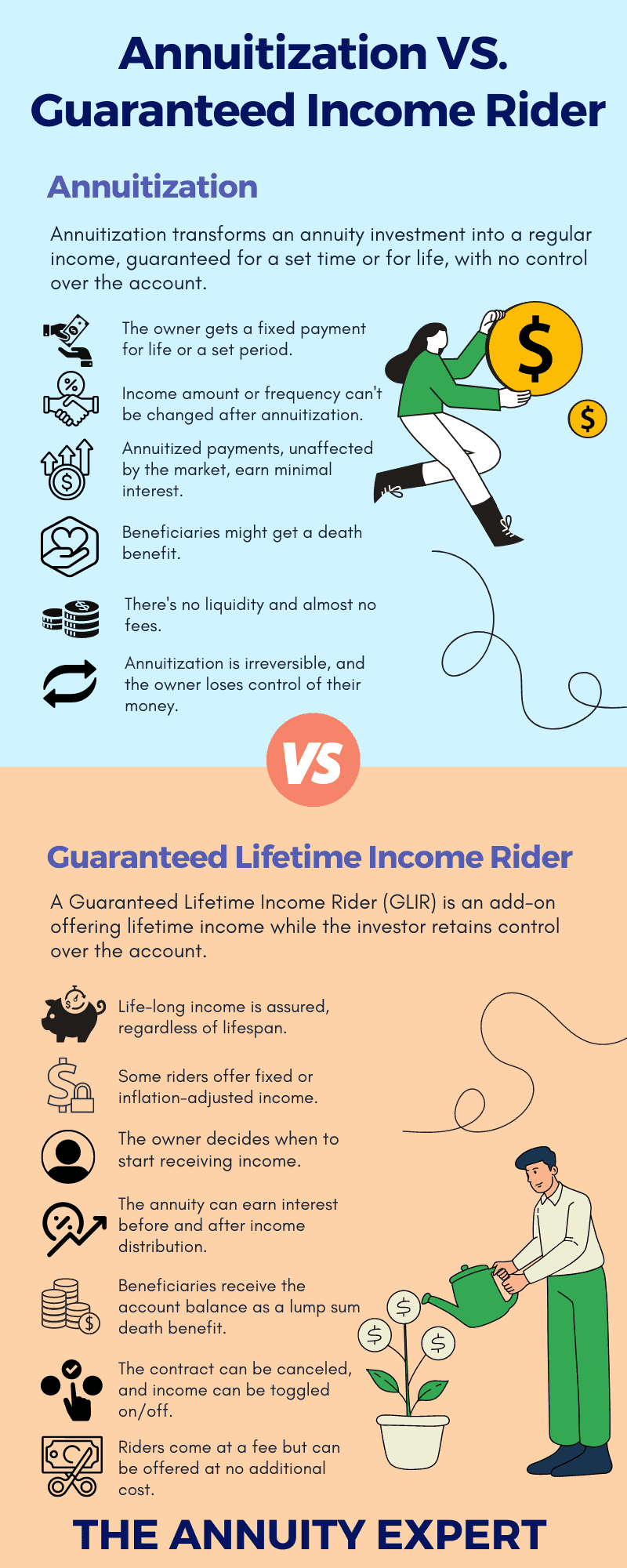
The “Old Way” vs. the “New Way” to Get Annuity Income
The Old Way: Annuitization (SPIA)
With annuitization, often through a Single Premium Immediate Annuity (SPIA), you convert the $200,000 premium into an income stream.
Pros:
- Simple lifetime-payment structure
- Often produces a competitive immediate payout
Cons:
- The decision is generally irreversible
- Principal is no longer available as an account balance
- Refund or period-certain protections usually reduce the payment
The New Way: Income Riders (GLWBs)
A Guaranteed Lifetime Withdrawal Benefit (GLWB) can be attached to a deferred annuity, often a fixed indexed annuity. It can provide lifetime withdrawals without requiring you to annuitize the contract.
Pros:
- You retain ownership of the annuity account
- Lifetime withdrawals can continue even if the account value is depleted under the contract terms
- Any remaining account value can pass to beneficiaries
Cons:
- The account remains subject to surrender charges and withdrawal limits
- Income-rider fees may apply
- Excess withdrawals can reduce or terminate the income guarantee
Compare nearby premiums: Review the $150,000 annuity payout and $250,000 annuity payout before deciding how much to allocate.
A Practical $200,000 Retirement-Income Example
At age 65, the immediate life-only benchmark is approximately $1,200 per month for a male and $1,120 per month for a female. A payment around this level could replace a modest pension, cover housing costs, or close the gap between Social Security and essential spending without requiring the retiree to sell investments each month.
How a $200,000 Annuity Fits Into a Retirement Plan
Before committing $200,000, subtract dependable income such as Social Security and pensions from essential monthly expenses. The remaining gap—not the available account balance—helps determine how much premium should guarantee income and how much should remain liquid or available for other goals.
Who Could Benefit
- Retirees with a measurable gap between guaranteed income and essential spending
- People seeking an income source that is not dependent on daily market performance
- Couples who want survivor income built into the plan
Who Might Not Benefit
- People who need the full $200,000 for near-term liquidity
- Savers still years away from needing income who prioritize accumulation
- Anyone uncomfortable with surrender schedules or rider fees
If growth is more important than income today, compare fixed annuity rates before adding an income rider. If leaving money to family is the primary goal, life insurance may solve that need more directly for applicants who qualify.
Key Factors Influencing the Payout
- Interest rates: Higher long-term yields can support higher annuity payouts, but carrier pricing changes.
- Immediate vs. deferred income: Starting later may increase the payment but requires another income source during the delay.
- Inflation protection: Adding an increase normally reduces starting income. Compare the lower initial payment with the expected effect of inflation.
- Liquidity: Keep emergency funds outside the contract and review all surrender charges before purchase.
- Insurer strength: Annuity guarantees depend on the issuing insurer’s claims-paying ability. Annuities are not FDIC insured, and state guaranty association protection is subject to state limits and eligibility rules.
Tax Implications: What You Actually Keep
Qualified money (IRA or 401(k)):
- Distributions are generally taxed as ordinary income when funded entirely with pre-tax money
- Required Minimum Distributions (RMDs) may be satisfied by eligible annuity distributions, but the calculation and reporting still must be coordinated across accounts
Non-qualified money (cash or brokerage):
- Annuitization: The exclusion ratio generally allocates each payment between taxable earnings and a return of after-tax principal
- GLWB withdrawals: Non-qualified deferred annuity withdrawals are generally taxed earnings-first under LIFO until gains are exhausted
Tax treatment depends on ownership, funding source, contract design, and applicable law. Consult a qualified tax professional for advice about your situation.
See What Your $200,000 Can Really Pay
A $200,000 annuity can create dependable lifetime income, but the result depends on age, start date, payout design, carrier pricing, and how much liquidity or beneficiary protection you retain. The mathematical estimates above are a starting point—not a substitute for a current quote.
At The Annuity Expert, we’re an independent annuity broker. We compare contracts from multiple insurance companies and show the income, access, fees, survivor options, and trade-offs side by side.
Contact The Annuity Expert for free quotes and see what $200,000 could provide based on your age, state, timing, and retirement goals. There is no cost or obligation.
Book A Free Consultation
Get help from a licensed financial professional. This service is free of charge.
Let Us Answer Your Questions
Not quite ready for a meeting, but you have a question that needs answering? We’re happy to help. Leave an inquiry below, and one of our staff will respond via email.