

Start Here If You’ve Never Bought Life Insurance Before
Life insurance might not be right for you—but if it is, the biggest challenge isn’t finding a company. It’s cutting through the noise to understand which type actually fits your situation and which ones clearly don’t.
This guide covers every major type of life insurance sold in the United States, explained in plain language, with context that actually matters.
The goal: By the end, you’ll know what to consider, what to eliminate, and what to compare—before anyone tries to sell you anything.
Helpful Tip: Different carriers specialize in different policy types. A company that has the cheapest term rates might have terrible whole life options, which is why you must compare products across the best life insurance companies.
What Life Insurance Is Really Meant To Do
Life insurance solves one problem:
If you die, who is financially affected—and how badly?
Depending on your situation, life insurance may be used to:
- Replace income that disappears when a breadwinner dies.
- Pay off any remaining debt.
- Cover funeral expenses, which can average $7,000 to $10,000
- Protect a business when an owner dies
- Create certainty for a spouse, children, or heirs
Different policy types exist because those needs don’t all last the same amount of time.
How A Life Insurance Policy Works
Every policy has the same basic parts:
- Death benefit: The money paid to your beneficiaries when you die. The death benefit is also referred to as the “face value.”
- Premium: The amount of money you pay to keep the policy active
- Length of coverage: The policy term that is either temporary (term policy) or lifelong (permanent policy)
- Cash value: Money that builds up inside certain permanent policies, like a savings account
- Policy rules: What terms are guaranteed vs. what can change
Once you understand these, the product names matter a lot less.

Medical Underwriting Types
Life insurance companies assess risk differently depending on the product and your situation. Understanding these underwriting types helps you know what to expect when applying.
- Fully Underwritten (exam and records, lowest cost): This is the traditional method. It includes a medical exam, blood and urine tests, and a review of your medical records. Sometimes, extra tests are needed if something unusual shows up. This option is the most invasive but offers the best rates if you’re healthy. The insurance company does thorough checks, allowing it to provide lower prices. Expect this process to take 4-8 weeks.
- Accelerated Underwriting (no exam, data-based approval): No needles or doctor visits here. The insurance company uses data sources like prescription history, driving records, credit scores, and medical databases to make decisions. They also look at your application answers. Usually, this takes just days or even hours. It works best for younger, healthier individuals with clean histories. If you qualify, pricing is competitive with fully underwritten policies. However, if there are red flags, you may be sent back to traditional underwriting.
- Simplified Issue (health questions only): You answer health questions on the application, with no exam or medical records checked. Approval is faster, typically taking 1-2 weeks. However, it costs more than fully underwritten or accelerated options. This is because the insurance company has less information to work with. It’s a middle ground for those who want quick approval and are willing to pay more, or who have minor health issues that could complicate traditional underwriting.
- Guaranteed Issue (no health questions, highest cost): No health questions, no exams, and no records—everyone gets approved, no matter their health. This is the most expensive option per dollar of coverage since the insurance company has no information to rely on. It often includes graded death benefits, meaning limited payouts in the first 2-3 years for natural causes. This is a last resort for those who can’t qualify otherwise.
The key point: Your health impacts pricing and the options available—not whether you need coverage. If you’re declined or priced out of one type, consider a realistic alternative instead of giving up.
Helpful Tip: If you have severe pre-existing health conditions and have previously been declined for traditional coverage, your best option is usually guaranteed issue life insurance. Because these policies skip the medical questions entirely, acceptance is mandatory, though they do come with higher premiums and smaller death benefits.
“Life insurance underwriting isn’t one-size-fits-all. Your age, height and weight, overall health, medical history, lifestyle, and even family history all play a role in how a carrier evaluates risk and prices a policy. Different companies weigh these factors differently, which is why underwriting outcomes—and premiums—can vary so much from one insurer to another. The key is matching your specific profile to the carrier whose underwriting guidelines are the most favorable for you.”
Health Classifications (Rating Classes)
Once the insurance company reviews your application, it gives you a health classification, or rating class. This classification determines your premium within a specific underwriting type.
- Preferred Plus (or Super Preferred): This is the top rating class with the lowest premiums. It’s for people in excellent health. You should have no family history of major issues, ideal height/weight ratios, a clean driving record, and no prescriptions. Few people qualify here—insurance companies are very selective.
- Preferred: This indicates good health, but you may have a minor issue. This could be slightly elevated cholesterol that’s controlled, a manageable family history, or being a few pounds over the ideal range. Premiums are higher than Preferred Plus but still lower than standard rates.
- Standard Plus: This class reflects good health with some minor issues. You might be on a common medication, have controlled high blood pressure, or have a higher BMI. You still get better-than-average pricing, just not the top tiers.
- Standard: This is average health for your age. Most people fall into this category. You might have a few managed health conditions, take medications, or have some family history concerns. Premiums are higher than preferred classes but remain reasonable.
- Substandard (Table Ratings): This class shows below-average health. This may be due to major medical issues, risky hobbies, dangerous jobs, or a serious family history. Premiums can be 25%-500%+ higher than standard rates based on severity. Table ratings are usually labeled Table A/B/C or Table 1-16, with each step showing a premium increase.
- Declined: This means the insurance company considers you too risky to insure at any price. This can happen with serious health problems, recent major medical events, or very risky lifestyles.
Important: Different companies rate the same person differently. One carrier may offer Standard, while another may offer Preferred. Working with an independent agent is important. They can compare many carriers. This is especially true if you have health issues or family history concerns.
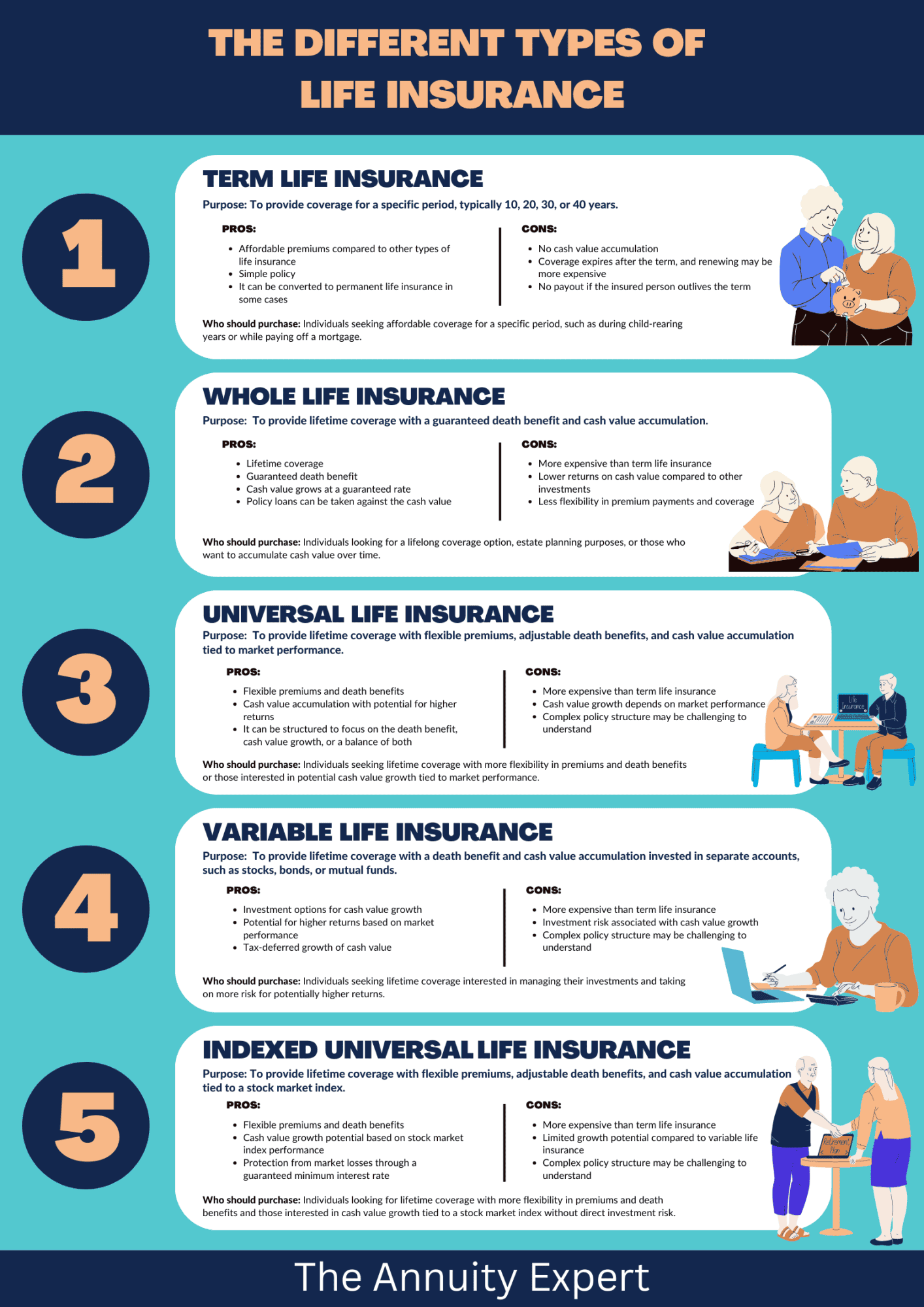
Match The Policy To Your Actual Needs
- Someone depends on your income → Term life.
- You’re a stay-at-home parent, and your spouse needs to replace your unpaid labor → Term life.
- You have kids and a mortgage → 20 or 30-year term.
- You want a backup plan for college expenses if you die → Term life that covers until kids graduate.
- You’re covering a co-signed loan with your kid or parent → Term life matching the loan length.
- Court ordered you to have coverage (divorce settlement, child support) → Term life, whatever meets the requirement.
- Cost matters most → Level term
- You want coverage now, but might want permanent later → Convertible term
- You want your premiums back if you don’t die → Return of premium term
- You need coverage for a specific declining debt → Level term (though decreasing term is also available)
- You need coverage for your entire life → Permanent life (Whole Life or GUL)
- You want lifetime certainty → Whole Life or GUL
- You want to leave money to kids, no matter when you die → Whole Life or GUL
- You have a special needs child or dependent who will need care forever → Permanent life (Whole Life or GUL)
- You’re covering estate taxes or capital gains taxes on assets you’re leaving behind → Permanent life (Second-to-Die policies work well here)
- You need to equalize inheritance among your kids (one gets the business, others get insurance money) → Permanent life.
- You want to leave money to a charity or cause → Permanent life
- You’re replacing pension or Social Security survivor benefits for your spouse → Permanent life or long-term term
- You have an unmarried partner who won’t get Social Security survivor benefits → Term or permanent, depending on the timeline
- You want to supplement retirement income using cash value → Overfunded Whole Life or IUL (advanced strategy, not for everyone)
- You’re protecting a business partner → Term or GUL, depending on how long the partnership lasts
- You’re covering business debt that doesn’t go away if you die → Term or permanent, depending on debt timeline
- You need funeral money covered → Final expense insurance
- You have health problems and can’t qualify for regular insurance → Guaranteed issue or graded benefit
Many people start with term life and reassess permanent coverage later when income is higher, and the need becomes clearer.
Term Life Insurance
Term life insurance is designed for temporary responsibilities—things that won’t last forever.
Level Term Life Insurance
- What it is: Term life with a level (flat) premium and level (flat) death benefit for a set period—usually 10, 20, 30, or 40 years.
- How it works: You pay the same amount every month or year for the entire term. If you die during that time, your family gets the money. If you’re still alive when the term ends, the coverage stops—you got what you paid for, and that’s it.
- Why people buy it: Because it’s the cheapest way to get a lot of coverage. A 30-year-old in good health can get $500,000 of coverage for around $30-40 a month. Nothing else comes close to that price.
- Who should buy it:
- Young families
- New homeowners
- Anyone with debt
- Those supporting dependents who count on their paycheck
- These groups need a clear “income replacement” plan.
- Who shouldn’t buy it: People whose need is truly lifelong (estate planning, a dependent who will always need care, final expenses with no savings to cover them). Also, skip it if you can’t realistically afford the premium for the full term.
- When to buy it: When you take on new obligations—marriage, kids, mortgage, business loan—or when you’re healthy and want to lock in a lower rate.
- When not to buy it: When you’re about to make big changes that will eliminate the need (paying off a house, selling a business), or if your budget isn’t stable enough to commit.
- Best companies: Banner, Pacific Life, Lincoln. All three are A+ rated and consistently among the best-priced carriers. Lincoln is especially strong on higher face amounts up to $2 million.
- Cost: The cheapest available option. The shorter the term, the cheaper the policy. A 20-year term could cost anywhere from $25-$100 a month for a $500,000 policy, for an ideal candidate, depending on age and health factors.
Convertible Term Life Insurance
- What it is: Term life insurance that allows you to switch to permanent coverage later. You don’t need to prove your health again. Just convert within the allowed timeframe, typically 10 to 20 years, depending on your policy.
- How it works: You buy cheap term insurance now. Later, if your health goes downhill or you decide you want lifetime coverage, you can convert to permanent insurance. No doctor visit. No blood work. No new health questions. You switch, and they have to approve you.
- Why people buy it: Because it’s insurance for your insurance. You get cheap coverage now, but you’re protected if you get sick and can’t qualify for new coverage later. Smart move if you’re young and healthy, but worried about what happens if that changes.
- Who should buy it:
- People early in their careers
- New parents
- Anyone with a family history of serious health issues, like cancer, heart disease, or diabetes
- Those who may want permanent coverage later but can’t afford $500 a month now
- Who shouldn’t buy it: People who are 100% certain they’ll never want permanent coverage and only care about the rock-bottom cheapest term premium possible.
- When to buy it: When you want affordable term now but want the option to upgrade later if your health tanks, your income goes up, or your financial goals change.
- When not to buy it: If the conversion rules suck (short conversion window, like only 5 years, or they only let you convert to crappy permanent products), or if the extra cost versus regular non-convertible term isn’t worth it.
- Best companies: Pacific Life, Transamerica. Most companies don’t actually want you to convert—they’d rather you buy expensive permanent insurance from the start—so their conversion options are usually mediocre. These two are the exceptions with better conversion features.
- Cost: The term policy itself costs about the same as regular term, maybe $5-10/month more. But if you actually convert? Your new premium jumps to roughly 10x what you were paying for term. That’s not a ripoff—that’s just what permanent coverage costs compared to temporary coverage.
Return Of Premium (ROP) Term Life
- What it is: Term life insurance that returns your premiums at the end of the term if you’re still alive. This only happens if you kept the policy active and met all conditions.
- How it works: You pay a significantly higher premium than a regular term. If you outlive the term, you get back what you paid in. This type usually excludes optional riders and fees, based on the policy.
- Why people buy it: They like the idea of “getting something back” if they don’t use the coverage.
- Who should buy it: People who are fully committed to keeping the policy for its entire term. They also value the peace of mind that comes with a refund more than simply getting the lowest price.
- Who shouldn’t buy it: Anyone who might cancel early, anyone on a tight budget, or anyone who’d be better off buying cheaper term and actually investing the difference (which most people don’t do, but if you will, do that instead).
- When to buy it: When you’re certain you’ll keep it for the entire term, and you’ve already handled the basics—emergency fund, high-interest debt paid off.
- When not to buy it: If there’s any real chance you’ll lapse or cancel, because you typically forfeit the refund if you don’t make it to the end.
- Best companies: Assurity and Cincinnati Life. Best combination of strong financial ratings and competitive pricing for ROP policies.
- Cost: Costs 3-6 times more than a standard term policy, based on term length. You get your premiums back if you outlive the term, which is the main benefit.
Decreasing Term Life Insurance
- What it is: A term life policy where the death benefit decreases over time. It’s often used to cover a declining debt, like a mortgage.
- How it works: Coverage starts higher but shrinks each year, usually on a set schedule.
- Why people buy it: They want coverage that mirrors a specific debt that gets smaller over time.
- Who should buy it: Someone who wants to cover one declining obligation and is okay with the benefit shrinking, even as living costs rise.
- Who shouldn’t buy it: Anyone needing a steady income for a family or wanting protection that lasts while expenses stay the same or increase.
- When to buy it: When the protection need is tightly tied to a debt schedule, and you’ve confirmed the decreasing benefit actually matches your payoff timeline.
- When not to buy it: Suppose you want coverage that stays level for family protection. Level term is usually a better fit.
- Best companies: Most companies have moved away from this type of coverage entirely. Aflac is the only carrier we’re aware of that still offers it, which should tell you something about how popular (or unpopular) it is.
- Cost: Your premium typically stays level, but your death benefit decreases over time. So you’re paying the same amount each year for less and less coverage, which is why most people are better off with level term at a similar price point.
Annual Renewable Term (ART)
- What it is: Term life that renews every year, with premiums that increase each year as you age.
- How it works: You can renew annually without reapplying for coverage, but the cost typically rises sharply over time, sometimes doubling or tripling within a decade.
- Why people buy it: Very short-term coverage is needed to fill a temporary gap.
- Who should buy it: People who genuinely need coverage for a short window (1–3 years) and have a real plan to replace it with level term or let it drop.
- Who shouldn’t buy it: Anyone who expects to need coverage for more than a few years. The math gets ugly fast.
- When to buy it: When you need coverage immediately for a short, defined period and you’ll switch to level term or cancel once the situation changes.
- When not to buy it: If your actual need is 10–30 years of protection. You’ll end up overpaying massively.
- Best companies: Prudential is our preferred choice for this option, but it’s not a policy type we recommend for most people.
- Cost: Starts cheap but increases every year as you age. Premiums can double or triple within a decade, making it prohibitively expensive if you keep it long-term. Only makes sense for very short coverage windows (1-3 years max).
Permanent Life Insurance
Permanent life insurance is meant to last your entire life, as long as it’s funded properly.
Whole Life Insurance
- What it is: Permanent life insurance with a steady premium. It offers a guaranteed death benefit and cash value growth. If it’s a participating policy, it may also provide dividends.
- How it works: You pay a fixed premium. Part covers insurance costs, part builds cash value. Coverage lasts for life as long as premiums are paid.
- Why people buy it: Lifetime coverage with predictable guarantees and no guesswork.
- Who should buy it: People who need lifelong coverage, value certainty over flexibility, and can commit to higher premiums long-term.
- Who shouldn’t buy it: Anyone who mainly needs affordable coverage for 10–30 years, or who might cancel early and lose most of what they paid in.
- When to buy it: When permanent coverage is truly the goal, and you’ve confirmed this need isn’t going away.
- When not to buy it: When cash flow is tight, or when term insurance would solve the actual need for a fraction of the cost.
- Best companies: MassMutual. They’ve been around for 200 years and have never missed a dividend payment—that kind of track record matters for a policy you’re planning to keep for life.
- Cost: The most expensive type of life insurance you can buy, but you’re paying for guarantees and permanence. A $500,000 policy for an ideal candidate at a standard rate can cost anywhere between $300 and $800 a month, depending on age and other health factors.
Universal Life Insurance
- What it is: Permanent life insurance with flexible premiums and cash value that can fluctuate.
- How it works: Premiums go into the policy. Monthly charges are taken out. The leftover balance earns interest as cash value. If the cash value falls too low, you’ll need to contribute more to keep coverage from lapsing.
- Why people buy it: Premium flexibility and the ability to adjust coverage or payment schedules.
- Who should buy it: People who want permanent coverage but prefer flexibility and are willing to monitor the policy over time—this isn’t a “set it and forget it” product.
- Who shouldn’t buy it: People who want hands-off simplicity or who won’t actually look at annual statements.
- When to buy it: When you understand the moving parts and are willing to manage it like you would any other financial account.
- When not to buy it: If you’re buying it because someone pitched it as “guaranteed” when it isn’t, or if you want true guarantees—get guaranteed UL or whole life instead.
- Best companies: Pacific Life is the cheapest, and Prudential also offers competitive pricing. That said, we generally recommend GUL for the guarantees or IUL for higher crediting potential—basic universal life requires more babysitting than most people want to deal with.
- Cost: More expensive than term, less expensive than whole life. The real cost depends on how well you fund it and whether policy charges eat into your cash value over time, which is why monitoring matters.
Guaranteed Universal Life Insurance
- What it is: A universal life design laser-focused on a guaranteed death benefit, with minimal cash value accumulation.
- How it works: You pay premiums on schedule according to the guarantee rules. If you follow those rules, the death benefit stays in force—period.
- Why people buy it: Long-term or lifetime death benefit certainty at a more controlled cost than whole life, without worrying about performance.
- Who should buy it: People who want permanent coverage and care more about locking in the death benefit than building cash value.
- Who shouldn’t buy it: People who want meaningful liquidity from cash value, or who might miss required payments (missing payments can void the guarantee).
- When to buy it: When the goal is permanent coverage with clear guarantees and no surprises.
- When not to buy it: If you need to access cash value down the road, or if you can’t reliably make the scheduled payments.
- Best companies: Pacific Life is the cheapest. Corebridge and Prudential also offer good pricing and solid living benefit options, plus they’re highly rated for financial strength.
- Cost: More expensive than term, cheaper than whole life. A $500,000 policy for an ideal candidate using standard rates can be anywhere between $150-$650 a month. You’re paying for a guaranteed death benefit without the cash value accumulation of whole life, which is why it costs less. The trade-off is straightforward: lower premium in exchange for minimal cash value growth.
Indexed Universal Life Insurance
- What it is: Universal life insurance that links cash value growth to a market index, such as the S&P 500. It has limits on gains and protections against losses.
- How it works: Cash value earns interest from index performance. However, your gains are capped by limits and spreads. Policy charges still apply, no matter the performance.
- Why people buy it: Potential for higher credited interest than traditional UL, with some downside protection (usually a 0% floor).
- Who should buy it: People who need permanent coverage, understand this isn’t the same as directly investing in the market, and can fund and monitor the policy properly.
- Who shouldn’t buy it: People buying it mainly because of “investment” hype, or who think it’s guaranteed to perform well. It’s not. Also, skip it if you won’t monitor performance and adjust funding when needed.
- When to buy it: When permanent insurance is legitimately needed, and you’re willing to review performance regularly and adjust course if things underperform.
- When not to buy it: If the illustration or sales pitch only works under best-case assumptions, or if missing payments would collapse the policy.
- Best companies: Securian Life, Allianz, and Protective are consistently solid choices. Like fixed indexed annuities, IUL performance relies on caps and spreads. This feature means the “best” company changes with market conditions and product designs. You need an independent agent. They research current options for your needs. They won’t just promote a product that was good last year.
- Cost: Similar to traditional universal life. The difference isn’t in the base cost, it’s in how the policy credits interest and whether that crediting keeps pace with policy charges over time.
Variable Universal Life Insurance
- What it is: Universal life insurance with cash value invested in market subaccounts, like mutual funds. This means values can go up or down based on market performance.
- How it works: Premiums go in, insurance and admin costs come out, and the remaining cash value is invested based on your choices. Market drops can eat into cash value and require higher funding to keep coverage in force.
- Why people buy it: Maximum upside potential with direct investment control inside a life insurance policy.
- Who should buy it: Experienced investors with high, stable income who can weather market downturns and are comfortable with risk.
- Who shouldn’t buy it: Most first-time buyers, anyone who needs guarantees, or anyone who can’t stomach watching their cash value drop 30%+ in a bad market.
- When to buy it: When you have a specific, sophisticated reason (like tax-advantaged wealth accumulation) and can manage the ongoing risks.
- When not to buy it: If you can’t commit to monitoring and funding long-term, or if a market crash would force you to abandon the policy.
- Best companies: Always changing like an IUL policy, the best options shift based on subaccount performance, fee structures, and available investment options. Work with an independent agent who can evaluate current offerings across multiple carriers.
- Cost: Similar to other universal life products, but with added subaccount fees and fund expenses on top of standard policy charges. If the market tanks, you may need to pump in significantly more money to keep the policy from lapsing—so budget for volatility, not just the minimum premium.
Survivorship (Second-To-Die) Life Insurance
- What it is: One policy covering two people (usually spouses) that pays out after the second person dies.
- How it works: Coverage lasts until both insured individuals pass away. Then, it pays the death benefit. This is often used for estate planning and legacy goals.
- Why people buy it: Liquidity for estate settlement, estate taxes, or leaving a legacy to heirs or charity.
- Who should buy it: Couples with estate planning needs where the payout timing at the second death makes sense.
- Who shouldn’t buy it: Anyone who needs financial protection at the first death—this policy doesn’t pay until both people are gone.
- When to buy it: When the financial need is specifically at the second death, and the surviving spouse will be okay financially after the first death.
- When not to buy it: If the surviving spouse would struggle financially after the first death, get individual policies instead.
- Insider Tip: Companies permit one uninsurable person on these policies. They pay out only after the second death, spreading the risk across two lives. For instance, if one spouse has active cancer and can’t get coverage, a second-to-die policy can still apply. The other spouse’s health helps balance the risk.
- Best companies: Prudential, Corebridge, and Lincoln are the top choices. This policy is a cost-driven product, and these three consistently offer the best pricing while maintaining strong financial ratings.
- Cost: More in line with IUL pricing, sometimes a bit cheaper. Since the policy only pays after both people die, premiums are lower than insuring each person separately, which is the whole economic advantage of this design.
Joint Life (First-To-Die) Insurance
- What it is: One policy covering two people that pays on the first death and typically ends after that payout.
- How it works: Pays at the first death, then coverage ends (unless the policy has continuation options, which some do).
- Why people buy it: Protect the survivor and cover shared obligations like a mortgage or business debt.
- Who should buy it: Couples who need money immediately when the first person dies and don’t need ongoing coverage after that.
- Who shouldn’t buy it: Anyone who needs coverage to continue after the first death, or who wants both spouses covered independently.
- When to buy it: When the need is specifically triggered by the first death, like paying off a business loan or covering final expenses.
- When not to buy it: If separate, long-term coverage for each spouse is important, individual policies are usually a better fit.
- Best companies: Companies have largely gotten away from this product. Assurity used to be the best option, but they no longer offer it—which should tell you something about market demand.
Modified Whole Life Insurance
- What it is: Whole life with lower premiums early on that increase to a higher level later (usually after 5–10 years).
- How it works: You pay a lower premium at first. Then, it increases to a higher, but still, level premium for the rest of the policy.
- Why people buy it: Lower start-up cost makes permanent coverage more accessible now, with the assumption that income will rise later.
- Who should buy it: People who are confident they can handle the premium jump when it comes, or who expect income to increase significantly.
- Who shouldn’t buy it: Anyone likely to struggle when premiums increase—you could end up canceling and losing most of what you paid in.
- When to buy it: When permanent coverage is needed, and future income is reasonably expected to rise (early career professionals, business owners, etc.).
- When not to buy it: If the premium increase would cause a lapse, or if your income situation is unpredictable.
- Best companies: SBLI offers the best combination of competitive pricing and strong financial ratings for modified whole life.
- Cost: Starts lower than traditional whole life, then jumps to a higher (but still level) premium after the initial period—usually 5-10 years. Make sure you can actually handle that increase before you commit, or you’ll end up canceling and losing most of what you paid in.
Juvenile Life Insurance
- What it is: Permanent life insurance purchased on a child, usually by a parent or grandparent.
- How it works: Parents pay premiums while the child is young. The policy builds cash value and locks in insurability for life, regardless of future health changes.
- Why people buy it: Lock in future insurability and take advantage of a long time horizon for cash value growth.
- Who should buy it: Families who already have solid coverage for the main earners and want a secondary long-term planning tool for the child.
- Who shouldn’t buy it: Families diverting money from protecting the household’s main income earners—parents should be fully covered first.
- When to buy it: After the parents’ own coverage is in place and other financial priorities (emergency fund, debt) are handled.
- When not to buy it: When it replaces higher-priority financial needs, or when the family can’t afford it without sacrificing protection for the adults.
- Best companies: Gerber’s Grow Up Plan is the industry standard for juvenile life insurance; it has essentially owned this market for decades.
- Cost: Cheaper than adult whole life policies because you’re insuring a young, healthy child with extremely low mortality risk. The trade-off is that it doesn’t build significant cash value—at least not for many years—so don’t buy this thinking it’s a great investment vehicle.
Alternatives To Paying For Permanent Life Insurance For The Rest Of Your Life
Limited-Pay Life Insurance
- What it is: A permanent policy designed to be fully paid up after a set number of years (like 10 or 20) or by a target age (like 65).
- How it works: You pay higher premiums for a shorter period, then you’re done—no more required premiums, and coverage lasts for life.
- Why people buy it: Permanent coverage without being locked into payments forever.
- Who should buy it: People with strong cash flow during peak earning years who want to front-load the cost and be done with it.
- Who shouldn’t buy it: Anyone who can’t sustain the higher premiums without straining their budget—missing payments defeats the entire purpose.
- When to buy it: When permanent coverage is the goal, and you can realistically fund it with a substantial upfront payment.
- When not to buy it: When income is uncertain, or there’s a real chance you’ll need to stop payments early.
- Best companies: SBLI offers the best pricing for limited-pay whole life policies.
- Cost: Higher premiums than regular whole life because you’re compressing all the payments into a shorter timeframe (like 10 or 20 years instead of your entire life). You pay more per year, but you’re done paying sooner, and coverage stays in force for life once it’s paid up.
Single-Pay Life Insurance
- What it is: A permanent policy funded with one lump-sum premium—pay once, done forever.
- How it works: You write one check, and the policy is intended to stay in force for life. Its structure may classify it as a Modified Endowment Contract (MEC). This classification impacts how withdrawals are taxed.
- Why people buy it: Permanent coverage with zero ongoing premiums—no risk of missing a payment.
- Who should buy it: People with surplus cash who are comfortable locking it up long-term and don’t need immediate liquidity.
- Who shouldn’t buy it: Anyone who might need that money back soon—this isn’t a liquid asset.
- When to buy it: When you want coverage paid up immediately and have a lump sum sitting around with no better use.
- When not to buy it: When liquidity is a priority, or you’re not certain about tying up that cash permanently.
- Best companies: MassMutual is the top choice for single-pay whole life—their dividend track record and financial strength matter even more when you’re putting down a large lump sum upfront.
- Cost: One large upfront payment instead of ongoing premiums—typically tens of thousands to hundreds of thousands, depending on coverage amount and your age. Expensive in the moment, but you’re done paying forever. Just make sure you’re comfortable tying up that cash permanently, because liquidity is limited, especially in early years.
Blended Or Overfunded Permanent Policies
- What it is: A permanent policy intentionally funded above the minimum required premium to strengthen long-term performance and cash value growth.
- How it works: Extra funding accelerates cash value accumulation and can improve policy stability. Overfund too aggressively, though, and you trigger MEC rules, which change how taxes apply to withdrawals.
- Why people buy it: Stronger long-term policy design, better cash value potential, and more cushion against underperformance.
- Who should buy it: People with stable cash flow who want permanent coverage and are disciplined enough to stick to a funding plan.
- Who shouldn’t buy it: Anyone who can’t commit to consistent funding or who doesn’t want to manage the complexity—this requires attention.
- When to buy it: When you want a more robust permanent policy and can fund it properly without creating financial strain elsewhere.
- When not to buy it: When cash flow is uncertain, or short-term liquidity is more important than long-term policy performance.
- Best companies: MassMutual is the go-to for overfunded whole life designs. Their dividend performance and policy design work well when you’re pumping extra money into the policy.
- Cost: Designed to exceed the minimum required premiums, you intentionally overfund to accelerate cash value growth and strengthen long-term performance. Just don’t overfund so aggressively that you trigger MEC status, which changes the tax treatment of withdrawals.
Special-Purpose Life Insurance Types
Final Expense / Burial Insurance
- What it is: A smaller face-amount policy (usually $5,000–$25,000) specifically designed to cover funeral costs and end-of-life bills.
- How it works: Premiums are paid, and when you die, the death benefit is paid to your beneficiary to cover final expenses—funeral, cremation, outstanding medical bills, etc.
- Why people buy it: To prevent funeral costs from becoming a burden on family members who are already dealing with loss.
- Who should buy it: People without savings earmarked for final expenses, or who want a simple, guaranteed payout without tying up cash.
- Who shouldn’t buy it: People who already have savings set aside specifically for this, or who need extensive income-replacement coverage—this won’t cut it for that.
- When to buy it: When nearing retirement or already retired and wanting straightforward, affordable coverage for end-of-life costs.
- When not to buy it: If you need more extensive coverage for income replacement, term life is the better fit for that.
- Best companies: Mutual of Omaha and Transamerica, as they both have solid financial ratings and simplified underwriting processes that make this type of coverage accessible.
- Cost: More expensive per thousand dollars of coverage than term life, but the face amounts are much smaller ($5,000-$25,000 typically). You’re paying extra for simplified underwriting and easier approval—convenience costs money, but for people with health issues, it’s often the only realistic option.
Graded Death Benefit Life Insurance
- What it is: A policy that doesn’t pay the full death benefit right away if you die from natural causes in the first 2–3 years. However, accidental death usually pays in full immediately.
- How it works: If you die early from illness or natural causes, beneficiaries may receive either the premiums paid, plus interest, or a portion of the face amount. After the graded period, full benefits kick in.
- Why people buy it: It’s often one of the only options available for people with serious health issues who can’t qualify for standard coverage.
- Who should buy it: People who can’t qualify for immediate full coverage anywhere else and need something in place.
- Who shouldn’t buy it: People who can qualify for level death benefits with another carrier—shop around first.
- When to buy it: After being declined for traditional coverage, and confirming this is the best available option.
- When not to buy it: When immediate full coverage is critical (like covering a specific debt right away).
- Best companies: Gerber Life is the most recognized name in this space. They’ve been writing guaranteed issue coverage for decades.
- Cost: Higher per dollar of coverage than standard final expense because there’s zero underwriting and limited early benefits. You’re paying for guaranteed acceptance regardless of health, which means the insurance company is taking on more risk, which gets priced in.
Credit Life Insurance
- What it is: Life insurance tied directly to a loan (mortgage, car loan, personal loan) that pays the lender if you die while the debt is outstanding.
- How it works: The death benefit typically matches the loan balance and decreases as you pay it down. The lender is the beneficiary, not your family.
- Why people buy it: Convenience at the point of purchase—it’s offered when you’re signing loan paperwork.
- Who should buy it: People who genuinely can’t qualify for term life and want one specific debt covered if they die.
- Who shouldn’t buy it: Most people who can qualify for term life—credit life is usually overpriced, inflexible, and your family gets nothing.
- When to buy it: Only when insurability options are extremely limited, and you have no other way to cover the debt.
- When not to buy it: When term life is available—term is almost always cheaper, more flexible, and your beneficiaries control the money.
- Best companies: Lloyd’s of London. This is a specialized policy that many companies don’t offer.
- Cost: Almost always overpriced compared to term life because you’re paying a convenience premium for coverage bundled with a loan. The lender is the beneficiary, not your family, and the death benefit decreases as you pay down the loan. If you can qualify for term life, that’s nearly always a better deal.
Accidental Death Insurance (AD&D)
- What it is: Insurance that only pays if death occurs from a covered accident—no payout for illness, natural causes, or most other ways people actually die.
- How it works: Premiums are low because the payout scenarios are extremely narrow. If you die in a car crash, it pays. If you die from cancer, heart disease, or just about anything else, nothing.
- Why people buy it: Easy approval, low cost, and it feels like “something is better than nothing.”
- Who should buy it: People who want a supplement to real coverage, or who genuinely can’t qualify for traditional life insurance and need any coverage they can get.
- Who shouldn’t buy it: Anyone using it as their main or only life insurance—most deaths aren’t from accidents, so this is a gamble with bad odds.
- When to buy it: As an add-on to actual life insurance, not as your foundation.
- When not to buy it: When the goal is true income replacement or covering dependents—this won’t do the job.
- Best companies: Lloyd’s of London. They specialize in unique policy structures like AD&D that most traditional life carriers don’t emphasize.
- Cost: Very cheap compared to traditional life insurance—sometimes just a few dollars per month—because it only pays for accidental death, which represents a tiny fraction of how people actually die. You get what you pay for: narrow coverage at a low price.
Employer-Based Life Insurance
Employer-Provided Group Term Life
- What it is: Group term life coverage offered through your employer, usually at little or no cost for a base amount.
- How it works: Coverage is tied to your employment and typically ends (or becomes expensive to continue) when you leave the job.
- Why people buy it: Easy enrollment, often subsidized or free for basic coverage, and requires minimal or no underwriting.
- Who should buy it: Employees who want a baseline benefit and understand it’s not a long-term solution.
- Who shouldn’t buy it: Anyone who needs long-term coverage independent of their job—this disappears when you quit, get laid off, or retire.
- When to buy it: When it’s offered—there’s usually no reason to decline free or cheap coverage, even if it’s not enough on its own.
- When not to buy it: Never as your only coverage if you have real dependents or financial obligations.
- Best companies: You don’t get a choice; your employer picks the carrier. You’re stuck with whatever company they choose. Typically, they choose the company that offers the best rate.
- Cost: Often free or heavily subsidized for basic coverage (like 1-2x your salary). It’s part of your benefits package, which is why you should take it—but don’t mistake cheap or free for adequate.
Voluntary Life Insurance
- What it is: Optional extra coverage you can buy through your employer, beyond the basic group life benefit.
- How it works: Premiums are deducted from your paycheck. Depending on the amount, you may need to answer health questions or provide evidence of insurability.
- Why people buy it: Convenience, payroll deduction, and group access can make it easier to get coverage than applying individually.
- Who should buy it: People who want to add coverage quickly without going through a full individual application process.
- Who shouldn’t buy it: People wanting full control long-term—portability is often limited or expensive, and rates can increase with age.
- When to buy it: During open enrollment, when guaranteed issue amounts may be available without health questions.
- When not to buy it: If costs rise sharply as you age, portability is weak, or you can get better individual coverage elsewhere.
- Best companies: You don’t get a choice—your employer selects the carrier, same as with group term. You’re stuck with whoever they contracted with.
- Cost: Typically deducted from your paycheck at group rates, which can be cheaper than individual policies when you’re young and healthy. The catch is that rates often increase with age bands (like every 5 years), and portability is usually expensive or non-existent if you leave the job.
Life Insurance For Business Owners
Key Person Insurance
- What it is: Life insurance the business purchases on a key employee or owner, with the business named as the beneficiary.
- How it works: If that person dies, the policy pays the business to help cover lost revenue, recruitment costs, or operational disruption.
- Why people buy it: To stabilize the business financially after losing someone critical to operations or revenue generation.
- Who should buy it: Businesses that are heavily dependent on one person for sales, operations, client relationships, or expertise.
- Who shouldn’t buy it: Businesses without real financial exposure if that person died—don’t buy it just because someone said you should.
- When to buy it: When growth, debt obligations, or client concentration make the loss of a key person genuinely expensive.
- When not to buy it: When the coverage amount isn’t tied to an actual, quantifiable financial need.
- Best companies: Lloyd’s of London. They specialize in these types of business policies and typically have the best pricing because this is their core business, not a side product. Other carriers offer key person coverage, but Lloyd’s focuses on it.
- Cost: Depends on the key person’s age, health, coverage amount, and whether it’s term or permanent. Expect to pay more than personal coverage since the business owns and controls the policy, but it’s a legitimate business expense you can usually deduct.
Buy-Sell Agreement Insurance
- What it is: Life insurance designed to fund a buy-sell agreement, providing cash to buy out a deceased owner’s share of the business.
- How it works: When an owner dies, the policy provides liquidity so surviving owners can purchase the deceased owner’s interest without scrambling for cash or taking on debt.
- Why people buy it: To avoid disputes between surviving owners and heirs, and to ensure a smooth ownership transition.
- Who should buy it: Multi-owner businesses where ownership continuity matters and heirs shouldn’t (or don’t want to) become partners.
- Who shouldn’t buy it: Businesses without a formal buy-sell agreement or a clear valuation method—the insurance is useless without the legal framework.
- When to buy it: Early, while all owners are healthy and rates are lower—waiting until someone gets sick makes this expensive or impossible.
- When not to buy it: If there’s no actual buy-sell agreement in place—fix that first, then ensure it.
- Best companies: Lloyd’s of London. They specialize in business continuation planning and typically offer the most competitive pricing because it’s their main focus, not an afterthought. Other carriers write these policies, but Lloyd’s owns this space.
- Cost: Varies based on the number of owners, their ages and health, business valuation, and policy structure (term vs. permanent). The cost should be weighed against the alternative: a messy, expensive business dissolution or forced sale if an owner dies without funding in place.
Alternatives If You Can’t Qualify For Traditional Life Insurance
Annuities With Enhanced Death Benefits As Life Insurance Alternatives
- What it is: A fixed or fixed indexed annuity with optional enhanced death benefit features that can increase what beneficiaries receive when you die.
- How it works: You make a lump-sum deposit. The contract tracks a separate death benefit base. This base may get an immediate boost—often up to 50% on day one. This boost applies to the death benefit only, not what you can access while alive.
- Why people buy it: They can’t qualify for affordable life insurance but want a stronger benefit for heirs using money they already have sitting around.
- Who should buy it: People with available cash who want principal protection, modest growth potential, and a legacy option for beneficiaries.
- Who shouldn’t buy it: Anyone needing maximum death benefit leverage (life insurance offers much more bang for your buck) or who needs high liquidity.
- When to buy it: When life insurance is declined or prohibitively expensive, and leaving a legacy is still a priority.
- When not to buy it: When short-term access to the money is likely, surrender charges can be steep in early years.
- Best companies: Athene consistently offers strong, enhanced death benefit options on their fixed and fixed indexed annuities with competitive terms.
- Cost: No ongoing premiums—you make a lump-sum deposit. The “cost” is opportunity cost (locking up that money) and potential surrender charges if you need it back early. Some enhanced death benefit riders may have annual fees (like 0.50%-1.00% of the benefit base), but many are built into the contract at no extra charge.
Guaranteed Issue Or Graded Benefit Final Expense
- What it is: Easier-to-qualify coverage specifically for final expenses, sometimes with a waiting period (graded benefit) before full coverage kicks in.
- How it works: Minimal or no medical underwriting. If there’s a graded period, early-year death benefits may be limited (often returning premiums plus interest for natural causes).
- Why people buy it: It’s coverage when traditional policies aren’t available due to health issues.
- Who should buy it: People with significant health problems who mainly need to cover funeral and final expenses.
- Who shouldn’t buy it: People who can qualify for level, immediate benefits elsewhere—always shop around first.
- When to buy it: After being declined for standard coverage, or when simplified options are the only realistic path.
- When not to buy it: When full immediate coverage is required (like covering a specific debt right away).
- Best companies: Gerber is the most established name for guaranteed issue and graded benefit final expense coverage.
- Cost: Higher per dollar of coverage than standard final expense because you’re buying guaranteed acceptance with zero medical underwriting. The insurance company is taking on more risk by not screening applicants, and that gets baked into the premium. If you have a graded period, you’re also paying full premiums from day one, even though full benefits don’t kick in until year 2 or 3 for natural causes.
Employer Or Association Group Life Insurance
- What it is: Group coverage through your employer or professional association that may be easier to obtain than an individual policy.
- How it works: Enroll through work or membership; coverage often ends or becomes expensive when you leave the job or association.
- Why people buy it: Access and convenience, especially when health issues make individual coverage difficult.
- Who should buy it: People who can’t qualify individually or need a quick baseline layer of coverage.
- Who shouldn’t buy it: People needing long-term portable coverage that moves with them regardless of employment status.
- When to buy it: When guaranteed issue enrollment is available through your employer or association.
- When not to buy it: As your only coverage for major family responsibilities, it’s not stable enough.
Self-Funding A Death Benefit With Beneficiary Designations
- What it is: Building your own “death benefit” by consistently saving and investing, with beneficiaries properly designated on all accounts.
- How it works: Save and invest systematically, ensure all accounts have updated beneficiary designations, and hope you live long enough to accumulate a meaningful amount.
- Why people buy it: No underwriting, full control over the money, and you can access it while alive if needed.
- Who should buy it: People with time, discipline, and modest coverage needs who can’t or won’t qualify for traditional insurance.
- Who shouldn’t buy it: People needing immediate large coverage—if you die next year, your heirs get whatever’s in the account, not a predetermined death benefit.
- When to buy it: When insurance options are exhausted or prohibitively expensive, and the amount needed is modest enough to reasonably self-fund.
- When not to buy it: When an early death would create severe financial harm for your family—that’s exactly when life insurance is most valuable.
Why Use an Independent Life Insurance Agent
Life insurance is not standardized. Prices, features, underwriting, conversion options, and contract language vary wildly by company.
An independent life insurance agent:
- Works with multiple insurance companies (not just one)
- Can compare term and permanent policies side by side across carriers
- They are not locked into pushing one company’s products
Most importantly: This service is free to you. The policy costs the same whether you buy directly from a company or work with an independent agent—commissions are built into the premium either way.
Using an independent agent helps you:
- See better pricing and more options
- Avoid being steered into whatever pays the highest commission
- Match the policy to your actual situation instead of the company’s product lineup
This matters especially for long-term contracts, where mistakes are costly and difficult to reverse.
You shouldn’t buy from a captive insurance agent because they can only sell products from one company, not what’s best or cheapest for you. Agents at State Farm, Northwestern Mutual, and New York Life can’t shop the market—so you never see better options from competing carriers.
Life Insurance Research Rules For First-Time Buyers
You might decide you don’t need life insurance at all. That’s a perfectly good outcome. The point of this guide is to help you make a clear decision without getting played by hype, scare tactics, or cookie-cutter advice.
- Start with the consequence, not the product: Before you look at policy names, answer this: If I die tomorrow, what financial problem shows up? That’s what the policy should solve.
- Separate “how much” from “how long”: Most bad recommendations happen when people blur these together. Coverage amount = the dollar problem. Coverage length = how long the problem lasts.
- Assume nothing is standardized: Two policies can both be called “term” (or both “permanent”) and work completely differently. Conversion options, exclusions, living benefits, renewability, guarantees—they vary a lot, even within the same category.
- Be skeptical of extreme takes: If a YouTube video or blog post claims one type is always a scam or always the best move, they’re selling a narrative, not solving your problem.
- Insider tip: A lot of life insurance content online is written by freelancers with zero actual experience selling or servicing policies. If the content is one-sided or purely emotional, that’s a red flag.
- Term is the default for most first-time buyers: If your need is temporary—kids at home, a mortgage, income replacement during working years—term is usually the simplest, most cost-effective answer.
- Permanent insurance should earn its place: Permanent coverage can make sense when the need is truly lifelong: estate planning, a dependent who will always need care, a legacy goal that doesn’t go away. If the need isn’t permanent, the policy shouldn’t be either.
- Don’t buy complexity you won’t manage: Some permanent policies require ongoing monitoring and funding decisions. If you don’t want a policy you have to babysit, stick with designs built around guarantees and simplicity.
- Group life is a perk, not a plan: Employer coverage can be a good starting layer, but it’s tied to your job and often isn’t nearly enough if you have real dependents.
- Health changes the price, not the purpose: Underwriting determines what you qualify for and what it costs. If you’re declined or quoted an outrageous amount, pivot to a realistic alternative—don’t pretend the need disappeared.
- Know how compensation works so you don’t get played: Independent agents are typically paid by the insurance company when you buy a policy. The premium is usually the same whether you go direct or use an agent. What matters is whether you’re being shown real options and the trade-offs are explained honestly—or if you’re being steered toward whatever pays the highest commission.
Common Riders And Add-Ons
These optional features can materially change how a policy works over time:
- Accelerated death benefit: Access part of the death benefit early if you’re diagnosed with a terminal illness
- Waiver of premium: Policy stays in force without premium payments if you become disabled
- Child rider: Adds term coverage on your children
- Conversion rider: Lets you convert term to permanent without new underwriting
- Guaranteed insurability rider: Buy more coverage later without proving insurability
Not all riders are worth the cost; evaluate based on your actual situation.
What to Do Next
Once you understand the types, the next step is comparing real policies based on your age, health, income, and goals.
If you want help reviewing options, contact The Annuity Expert for free quotes and clear explanations before you buy. This is a free service.
Life insurance works best when the policy matches the problem you’re trying to solve.
Book A Free Consultation
Get help from a licensed financial professional. This service is free of charge.
Let Us Answer Your Questions
Not quite ready for a meeting, but you have a question that needs answering? We’re happy to help. Leave an inquiry below, and one of our staff will respond via email.