

Nassau Personal Protection Choice Annuity Review
The Nassau Personal Protection Choice is a fixed indexed annuity that attempts to combine guaranteed lifetime income, temporary enhanced income for qualifying health conditions, an enhanced death benefit, principal protection, and index-linked accumulation inside one contract.
That sounds attractive because the product is designed to cover several retirement concerns at once. The problem is that annuities generally do one job best. When one contract tries to handle income, long-term care, legacy planning, and accumulation, the buyer can end up paying for a complicated package that is not the best available option for any single goal.
We do not recommend purchasing the Nassau Personal Protection Choice annuity. Nassau is rated below our A- minimum with AM Best, the contract has a long surrender period, the rider and strategy fees can reduce the cash value, and the agent compensation is on the higher side for a fixed indexed annuity.
Our Professional Opinion on the Nassau Personal Protection Choice Annuity
We do not recommend the Nassau Personal Protection Choice for new annuity buyers because Nassau currently falls below our A- minimum AM Best standard.
This is a long-term insurance contract that may be responsible for providing income or death-benefit guarantees decades into the future. We do not see a reason to accept a B++ insurer when A- or better-rated companies offer competing lifetime-income, accumulation, care, and legacy products.
The company rating is not the only concern. Personal Protection Choice is a complicated product with several combinations of benefits. Buyers can select income, care protection, family protection, or a combination of all three. Each benefit has its own calculation value, eligibility rules, exclusions, and withdrawal consequences.
This is a Swiss Army knife annuity. That can look great during a sales presentation, but bundling several benefits together does not mean the contract performs each job better than a dedicated product.
The income-rider design is one of the better parts of the annuity. Nassau offers an Income Today version for buyers planning to start income relatively soon and an Income Tomorrow version for buyers planning a longer deferral. Both use contractually defined simple-interest growth of a separate Income Benefit Base.
We prefer contractual income-base growth over a performance-based rider that depends entirely on index returns and future renewal rates. However, a strong-looking roll-up does not guarantee the highest retirement paycheck.
The Income Benefit Base is not cash. It is a calculation value used to determine lifetime withdrawals and rider fees. You cannot surrender the contract and receive the Income Benefit Base as a lump sum.
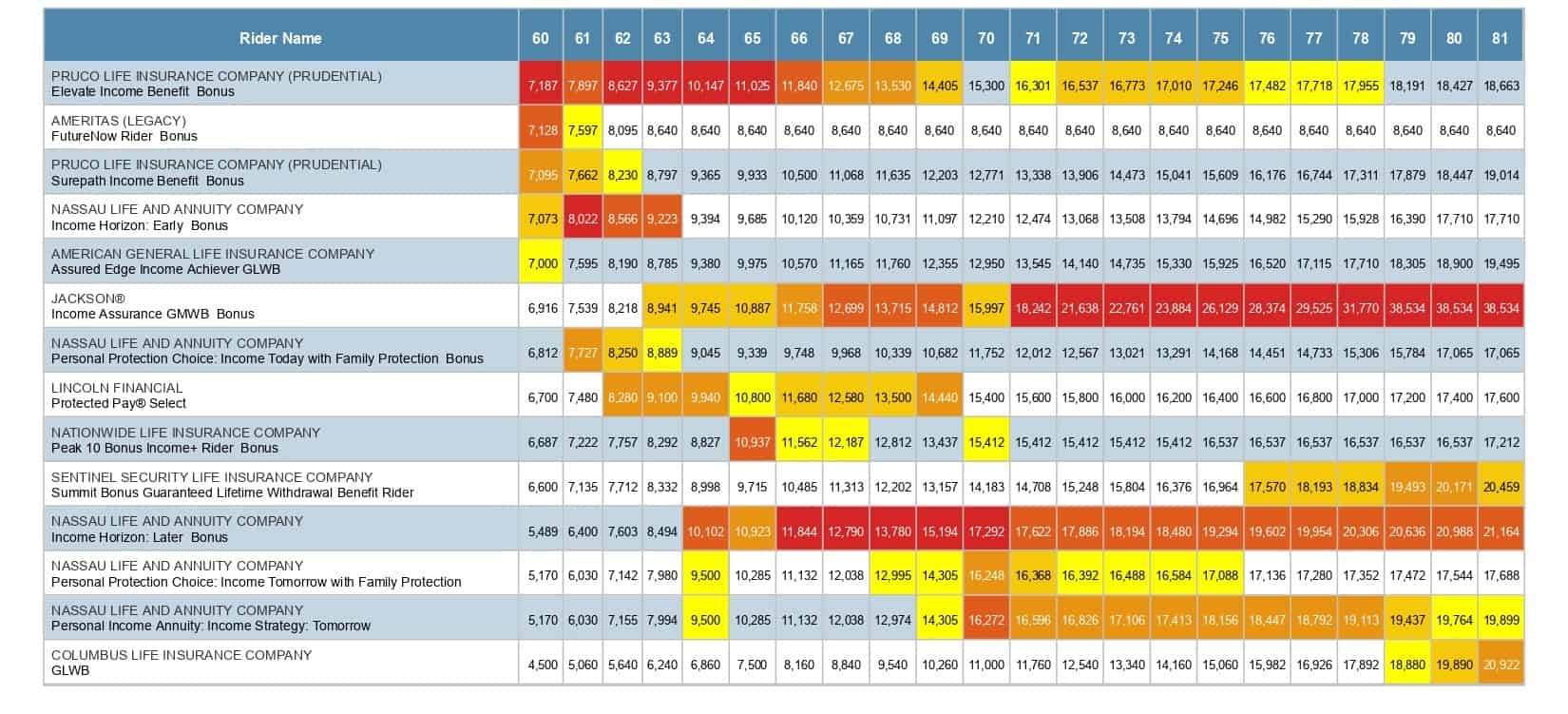
Therefore, we would compare the actual guaranteed annual income—not the bonus, roll-up, benefit-base size, or illustrated percentage. If an A- or better-rated insurer guarantees more income from the same premium, age, and start date, we would choose the stronger company and higher payout.
The Care Protection Benefit is useful on paper. It can temporarily increase income after the waiting period when the covered person meets the contract’s activities-of-daily-living or nursing-home requirements. Under the rider terms, qualifying enhanced payments can continue for the specified benefit period even after the accumulation value reaches zero when depletion results from scheduled rider payments or rider fees.
However, the care benefit has pre-existing-condition exclusions, requires medical proof and continued certification, and does not qualify as actual long-term care insurance. It is a temporary increase in the annuity payment—not a separate pool of benefits designed around the actual cost of home care, assisted living, or nursing-home care.
The Family Protection Benefit can create an enhanced death benefit for beneficiaries. We like that it may pay more than the standard contract value. The downside is that the benefit base is not cash, withdrawals reduce it proportionately, and using the income or care benefits can stop future growth.
The fee structure deserves serious attention. The annual combination-rider charge is based on the Income Benefit Base or the greater of the Income and Family Protection Benefit Bases—not simply the cash value. As those calculation values grow, the dollar amount of the fee can grow even when the actual accumulation value is flat or declining.
The fee comes directly out of the accumulation value. In a year with little or no credited interest, the rider fee can reduce the cash value. That can reduce liquidity, the standard death benefit, and the amount available if the buyer later decides to leave the contract.
We also do not like the fee-based index strategies. Nassau lets the owner pay a strategy fee for a higher participation rate on selected indexes. The higher rate is guaranteed only for the applicable segment, not the entire surrender period.
Paying a fee for more upside while the insurance company can change the rate at the next renewal stinks. The fee can also reduce the account value when the strategy earns little or no interest.
The contract includes true S&P 500 and Nasdaq-100 strategies, which we prefer over relying exclusively on engineered indexes. However, the traditional-index caps and participation rates can change when their segments renew. The fixed-account rate can also change annually.
The Smart Passage SG and UBS Tactical Multi Asset strategies add more complexity. The Smart Passage Sunrise method can remove the strongest monthly return from the calculation, while the UBS strategy applies a spread. Large headline participation rates on those strategies should not be compared directly with a simple S&P 500 cap.
The contract also has a long surrender period, an MVA, no bailout provision, and no standard loan provision. Although the contract allows annual penalty-free access and includes health-related waivers, buyers should use money they can leave in place for the entire surrender term.
Inside-baseball tip: The agent commission on this product is above average for a fixed indexed annuity. You do not write a separate check for the commission, but the insurer pays the financial professional from the economics of the product.
If an advisor is aggressively pitching this B++ annuity, the recommendation could be influenced by what benefits the advisor—not what is best for you. That does not automatically mean the advice is dishonest, but it creates a real conflict that deserves scrutiny.
Ask the advisor to disclose how they are compensated and show side-by-side quotes from several A- or better-rated companies. If the advisor cannot explain why Nassau provides a materially better guaranteed payout or benefit after fees, there is no reason to accept the weaker insurer.
Our bottom line: Nassau Personal Protection Choice has several useful features, but the overall package is not good enough to overcome the B++ AM Best rating, high compensation incentive, long surrender commitment, rider-fee drag, and renewal-rate risk. We would use an A- or better-rated annuity for income, accumulation, or death benefits and compare dedicated long-term care coverage separately.
Compare Personal Protection Choice With Today’s Best Fixed Indexed Annuities
The best annuity depends on whether the goal is lifetime income, accumulation, liquidity, enhanced death benefits, or care protection. One product does not need to handle every retirement problem.
What We Like
- Contractual Income-Base Growth: The Income Today and Income Tomorrow riders do not depend entirely on index performance to build the minimum income calculation value.
- Flexible Income Start: Eligible owners can choose when to begin lifetime withdrawals after satisfying the minimum-age requirement.
- Lifetime Income: Scheduled withdrawals can continue for life even after the accumulation value reaches zero, assuming the rider terms are followed.
- Single- and Spousal-Life Options: The income benefit can be structured to continue through the life of a surviving spouse.
- Temporary Care Enhancement: Qualifying ADL limitations or nursing-home confinement can increase the available income for the contract’s benefit period.
- Enhanced Death Benefit: The Family Protection Benefit can provide beneficiaries with more than the standard contract death benefit.
- Traditional Index Choices: The contract includes S&P 500 and Nasdaq-100 strategies in addition to engineered indexes.
- Annual Penalty-Free Access: The contract provides annual access to a portion of the accumulation value during the surrender period.
- RMD Treatment: Eligible required minimum distributions may receive favorable surrender-charge and MVA treatment under the contract provisions.
- Return-of-Premium Feature: In available states, the contract may protect the original premium after the surrender period, adjusted for withdrawals and rider fees, if the income rider has not been exercised.
- Health-Related Waivers: Qualifying terminal illness or nursing-home confinement can provide additional access under the contract provisions.
What We Don’t Like
- B++ AM Best Rating: Nassau falls below our A- minimum for new annuity recommendations.
- High Agent Compensation: The commission schedule is on the higher side for a fixed indexed annuity and can create a sales incentive.
- Complicated Product Design: Income, care, family protection, index strategies, and multiple calculation values make the contract difficult to evaluate.
- Rider Fee Based on Benefit Values: The dollar fee can grow as the Income or Family Protection Benefit Base grows, even when the cash value does not.
- Fee-Based Index Strategies: The owner pays for a higher current participation rate without locking that enhanced rate for the full surrender period.
- Account Value Can Decline From Fees: The zero-percent index floor applies before strategy fees and rider charges are deducted.
- Renewal-Rate Risk: Caps, participation rates, spreads, strategy fees, and the fixed rate can change at future renewals.
- Engineered Index Complexity: The Sunrise adjustment, volatility controls, and spreads can limit growth in ways that are difficult for the average buyer to evaluate.
- Long Surrender Period: Excess withdrawals can trigger surrender charges and an MVA for approximately a decade.
- No Bailout Provision: Unattractive renewal rates do not automatically permit the owner to leave without surrender charges.
- Care Benefit Is Not Long-Term Care Insurance: The benefit is temporary, has exclusions, and requires continued eligibility documentation.
- Withdrawals Can Damage Multiple Benefits: Withdrawals can reduce the income, care, and family-protection values at the same time.
- Return of Premium Has Conditions: It may be unavailable after exercising the income rider and is not offered in every state.
Nassau Personal Protection Choice Product Details
| Product Type | Single-Premium Deferred Fixed Indexed Annuity |
| Primary Purpose | Lifetime Income With Optional Care and Family-Protection Benefits |
| Surrender Period | Long-term surrender schedule of approximately a decade; state variations apply |
| Market Value Adjustment | Yes |
| Bailout Provision | No |
| Loan Provision | No |
| Income Options | Income Today and Income Tomorrow; single- or spousal-life coverage |
| Care Protection | Temporary enhanced income for qualifying ADL limitations or nursing-home confinement |
| Family Protection | Enhanced death-benefit calculation subject to rider terms and withdrawal reductions |
| Rider Fee | Annual charge based on the applicable Income or Family Protection Benefit Base |
| Index Options | S&P 500, Nasdaq-100, Smart Passage SG, UBS Tactical Multi Asset, and fixed interest |
| Crediting Periods | One- and two-year segments depending on the selected strategy |
| Strategy Fees | Optional on selected enhanced-participation strategies |
| Penalty-Free Access | Annual free-withdrawal amount plus qualifying RMD and health-waiver provisions |
| Return of Premium | Available in certain states and subject to contract conditions |
| Death Benefit | Standard contract death benefit or applicable enhanced Family Protection Benefit |
| AM Best Rating | B++ at the time of this review |
Nassau is not an annuity company we recommend for new purchases at this time. Its B++ AM Best rating is below our A- minimum, and stronger insurers offer competing income, accumulation, care, and legacy products. Our concerns with Personal Protection Choice involve both the insurer and the contract’s fees, complexity, surrender commitment, and renewal-rate risk.
Product options, state availability, rider names, fees, index strategies, and contract provisions can change. Review the current state-specific illustration, disclosure, and contract before purchasing.

How the Nassau Personal Protection Choice Annuity Works
You purchase the contract with a single premium and allocate the money among a fixed account and one or more index-linked strategies. The contract protects the accumulation value from direct losses caused by negative index performance, but fees, withdrawals, surrender charges, and an MVA can still reduce the amount available.
The optional Combination Benefit rider adds guaranteed lifetime income and can also include Care Protection, Family Protection, or both.
The contract can track several different values:
- Accumulation Value: The actual contract value used for withdrawals, surrender, and the standard death benefit.
- Cash Surrender Value: The amount available after applicable surrender charges, MVA, and pro-rated fees.
- Income Benefit Base: A noncash value used to calculate lifetime income and part of the rider fee.
- Family Protection Benefit Base: A noncash value used to calculate the enhanced death benefit and part of the rider fee.
Do not compare the benefit bases with the cash surrender value. A large rider value may support income or a death benefit, but it does not represent money the owner can walk away with.
Income Today vs. Income Tomorrow
Income Today
Income Today is designed for someone who expects to activate guaranteed income relatively soon. It starts with an immediate increase to the Income Benefit Base and then applies a contractually defined simple-interest roll-up while income is deferred.
This can produce a larger initial benefit value than simply starting with the premium. However, the bonus and roll-up are not cash and do not increase the accumulation value.
Income Tomorrow
Income Tomorrow is designed for a buyer who expects to wait longer before beginning lifetime withdrawals. It does not use the same immediate income-base bonus. Instead, it applies a larger contractual simple-interest roll-up during the initial deferral period.
The rider may offer a continuation or restart of roll-up growth after the initial period under newly declared terms. Those future terms may differ from the original contract terms.
Neither option is automatically better. Income Today may work better for a shorter delay, while Income Tomorrow may work better for a longer delay. The answer depends on the actual guaranteed annual payout at the intended income date.
Compare Nassau Personal Protection Choice Income Payouts
Income payouts change as insurers adjust rider terms and product pricing. Your age, state, premium, single- or spousal-life coverage, benefit combination, and income start date can materially change which annuity pays the most.
Contact The Annuity Expert for a free custom annuity income heat map based on your actual information. We compare Nassau with current income annuities from A- or better-rated insurance companies.
Care Protection Benefit
The Care Protection Benefit can increase the income available when the covered person meets the contract’s qualification requirements.
The current rider generally recognizes two qualification levels:
- Inability to perform at least two of the six activities of daily living for the required period; or
- Qualifying nursing-home confinement connected to an inability to perform the required activities of daily living.
The benefit becomes available only after the rider’s waiting period and requires medical evidence. Eligibility must generally be reconfirmed while enhanced payments continue.
The amount of the enhancement depends on the issue age and qualification level. Nursing-home confinement can produce a larger enhancement than qualifying through ADL limitations alone.
The enhanced payment is available for a limited number of contract years. It does not reimburse actual care bills, and unused benefit amounts do not carry forward.
Pre-existing conditions matter. The rider includes lookback exclusions involving prior facility confinement, terminal illness, and certain cognitive conditions. Buyers with a relevant medical history should not assume the care benefit will be available.
Someone whose main concern is paying for care should compare dedicated long-term care coverage or a hybrid life and long-term care policy rather than relying entirely on an annuity income multiplier.
Family Protection Benefit
The Family Protection Benefit creates a separate death-benefit base that can grow while the rider remains in its accumulation phase.
The enhanced benefit may exceed the standard accumulation-value death benefit and is generally payable to the beneficiary as a lump sum under the rider terms.
However, the Family Protection Benefit Base has no cash value. It cannot be surrendered or withdrawn by the owner.
Withdrawals—including RMDs and guaranteed income payments—reduce the Family Protection Benefit Base proportionately. Using another rider benefit can also stop future growth.
There are also eligibility exclusions for certain recent facility confinements and terminal illnesses.
If leaving the largest possible inheritance is the primary objective, compare Nassau with the best annuities for enhanced death benefits and with life insurance.
Why the Combination Rider Fee Matters
The annual rider fee is deducted from the accumulation value after any applicable index credits are added.
For an income-and-care combination, the fee is based on the Income Benefit Base. For combinations that include Family Protection, the fee is based on the greater applicable Income or Family Protection Benefit Base.
This creates a potential mismatch: the fee can be calculated using a benefit value that is much larger than the actual cash value from which the fee is deducted.
As the benefit base grows, the dollar fee can grow. Nassau can also change the rider-fee percentage after the initial contract period, subject to the contractual maximum.
The fee may be reasonable when the product produces a top-tier guaranteed payout or a valuable death benefit. It is not reasonable when an A- or better-rated competitor provides more income or stronger protection with lower costs.
Index-Crediting and Fixed-Interest Options
Personal Protection Choice offers a fixed account and a broad menu of one- and two-year indexed segments.
The traditional index choices include:
- S&P 500 point-to-point with a cap
- S&P 500 point-to-point with a participation rate
- S&P 500 monthly point-to-point
- Nasdaq-100 point-to-point participation strategies
The engineered choices include the Smart Passage SG and UBS Tactical Multi Asset indexes.
We generally prefer transparent traditional indexes and one-year point-to-point crediting when the economics are competitive. The longer and more complicated the formula, the harder it becomes to understand what must happen before interest is credited.
The fixed account earns a declared rate for one year. Nassau can set a new rate at the next anniversary, so it should not be confused with a MYGA that guarantees the rate for several years.
Buyers who want more certainty should compare annuities designed to reduce renewal-rate risk through cap locks, participation-rate guarantees, or MYGA structures.
Strategy Fees and Renewal-Rate Risk
Selected index accounts are available in no-fee and fee-based versions. The fee-based version provides a higher current participation rate.
The strategy fee is deducted at the end of the segment and is based on the account value at the beginning of the segment. On a multi-year segment, the annual fee is multiplied by the number of years in the term.
If the index credit is smaller than the strategy fee, the account value decreases. The contract’s zero-percent index floor does not prevent a loss caused by the strategy fee.
Nassau can reset caps, participation rates, spreads, and strategy fees for future segments. The higher rate you pay for today may not be available at renewal.
We would not build a long-term accumulation plan around a fee-based participation rate Nassau can change later.
Liquidity, Surrender Charges, and MVA
Personal Protection Choice is a long-term contract with a surrender schedule lasting approximately a decade.
The contract permits an annual penalty-free withdrawal based on the accumulation value. Eligible RMDs and scheduled rider income may receive additional protection from surrender charges and an MVA.
Withdrawals above the permitted amount can be subject to surrender charges, a Market Value Adjustment, pro-rated strategy fees, and reductions to rider benefits.
A negative MVA can further reduce the amount received when interest rates have risen since the contract was issued. A positive MVA can increase the withdrawal when rates have fallen, subject to the contract limits.
Qualifying nursing-home confinement and terminal illness can waive the surrender charge, although an MVA may still apply under certain contract versions.
Buyers who prioritize access should compare the best annuities for liquidity before entering a long surrender schedule.
Return of Premium
In states where the feature is available, the return-of-premium surrender benefit applies after the surrender period and generally protects the original premium after subtracting prior withdrawals and income-rider fees.
The feature has an important limitation: it is no longer available after the income rider has been exercised.
That means the return-of-premium provision should not be described as a universal guarantee that applies throughout every use of the contract.
Death Benefit and Spousal Continuation
Before annuitization, the base contract generally pays the greater applicable value under the contract without the normal surrender charge or MVA.
A surviving spouse named as beneficiary may be able to continue the contract through spousal continuation instead of taking an immediate death benefit.
The Family Protection Benefit can provide an enhanced legacy value when it remains in force. Withdrawals, rider use, and other contract events can reduce that benefit.
Death benefits from a nonqualified annuity can pass directly to named beneficiaries and may avoid probate, but taxable gain is generally subject to ordinary income tax. Read our explanation of ways to avoid probate for broader estate-planning context.
Retirement Accounts Accepted
- Non-Qualified Funds
- Traditional IRA
- Roth IRA
- 401(k) Rollovers
- 403(b) Rollovers
- TSP Rollovers
- SEP IRA
- SIMPLE IRA
- 401(a) Plans
- 457 Plans
- Keogh Plans
- 1035 Exchanges

Who Was This Annuity Designed For?
On product design alone, Personal Protection Choice targets someone who:
- Wants guaranteed lifetime income and is deciding between a shorter or longer deferral period;
- Wants the possibility of temporarily enhanced payments after a qualifying health event;
- Wants an enhanced death benefit for beneficiaries;
- Can commit money through a long surrender period;
- Understands that several benefit values are not cash; and
- Is comfortable paying ongoing rider fees for bundled benefits.
We still would not recommend a new purchase because the insurer is below our A- minimum. Those same goals can be addressed through stronger insurance companies and, in many cases, through separate products that do each job better.
Who Should Buy Something Else?
- Anyone Requiring an A- or Better Insurer: Nassau does not meet our current minimum.
- Someone Seeking the Highest Lifetime Income: Another carrier may guarantee more income with a simpler rider.
- Someone Seeking Maximum Safe Growth: Rider fees and weak renewal terms can reduce accumulation.
- Someone Who Wants a Cap Lock: The traditional-index rates and fee-based enhancements can change at renewal.
- Someone Who Needs Strong Liquidity: The contract has a long surrender period and MVA.
- Someone Primarily Concerned About Long-Term Care: Dedicated coverage may provide broader benefits and clearer claims triggers.
- Someone Primarily Concerned About Legacy: Life insurance or a stronger enhanced-death-benefit annuity may provide a better result.
- Someone Who Wants Simplicity: The product contains several bases, rider combinations, exclusions, and fee structures.
What Existing Nassau Personal Protection Choice Owners Should Do
Existing owners should not automatically surrender the contract. A decision about keeping an existing annuity is different from deciding whether to make a new purchase.
A surrender or exchange could trigger surrender charges, a negative MVA, taxes, loss of rider benefits, or loss of an enhanced death benefit.
Request the following before making a decision:
- Current accumulation value and cash surrender value
- Remaining surrender period and current MVA
- Income Benefit Base and current guaranteed annual income
- Family Protection Benefit Base and current death benefit
- Annual rider charge in dollars
- Current caps, participation rates, spreads, fixed rate, and strategy fees
- Tax basis and taxable gain
- Effect of future RMDs or planned withdrawals on every rider benefit
Then compare the current contract with what the transferable cash surrender value can purchase today from A- or better-rated insurers. Request a free annuity second opinion before replacing the policy.
Better Alternatives to Nassau Personal Protection Choice
For Guaranteed Lifetime Income
Compare fixed indexed annuities with contractual guaranteed roll-ups from A- or better-rated insurers. Select the product that guarantees the most actual annual income for the desired start date—not the product with the largest advertised benefit-base growth rate.
For Safe Accumulation
Use an accumulation-focused FIA with transparent traditional indexes and contractual rate guarantees, or a MYGA when a fixed return is the priority. There is little reason to pay income, care, and legacy rider fees when those benefits are not needed.
For Long-Term Care
Compare traditional long-term care insurance, a hybrid policy, or an annuity specifically designed for long-term care benefits. Dedicated coverage may provide a larger and more flexible benefit pool than a temporary income multiplier.
For Leaving Money to Family
Compare life insurance and annuities designed specifically for enhanced death benefits. A dedicated legacy product may provide a larger and simpler benefit than bundling the feature with lifetime income and care protection.
Other Insurance to Consider
Life insurance can provide a predictable tax-advantaged death benefit when the applicant qualifies medically. It may be a better estate-planning tool than paying for a rider whose benefit is reduced by withdrawals and other contract activity.
Long-term care insurance can create a separate pool of benefits for home care, assisted living, and nursing-home expenses. A hybrid policy can combine a death benefit with long-term care protection when the buyer wants both benefits inside one policy.
What We Recommend
We do not recommend purchasing the Nassau Personal Protection Choice annuity.
The product includes useful income, care, and legacy features, but Nassau’s B++ AM Best rating falls below our A- minimum. The contract also has a high advisor compensation incentive, a long surrender commitment, complicated rider mechanics, benefit-base fees, strategy fees, and renewal-rate risk.
We recommend comparing A- or better-rated companies separately for each goal: lifetime income, safe accumulation, long-term care, and leaving money to beneficiaries.
Contact The Annuity Expert for free quotes and a no-obligation comparison. We will compare the actual guaranteed income, insurer strength, fees, surrender terms, liquidity, care benefits, and death benefits rather than relying on a sales illustration.

Book A Free Consultation
Get help from a licensed financial professional. This service is free of charge.
Let Us Answer Your Questions
Not quite ready for a meeting, but you have a question that needs answering? We’re happy to help. Leave an inquiry below, and one of our staff will respond via email.
Related Reviews
- Pacific Life Pacific Income Provider
- F&G Safe Income Advantage Annuity
- Midland Income Planning Annuity
- Integrity Life Income Source Annuity
- Symetra Freedom Income Annuity
- Lincoln Financial Insured Income Annuity
- Allianz Benefit Control Annuity
- Nationwide Income Promise Select Annuity
- Athene Agility Annuity
- American Equity Annuity Reviews
- Oceanview Life and Annuity Review